Van Hise Rock, Rock formation in Excelsior, US.
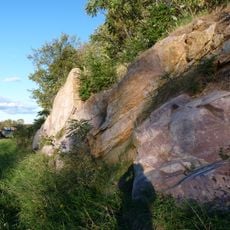
Van Hise Rock is a quartzite outcrop in the Baraboo Hills of Wisconsin, showing pink and purple stone with clearly visible folded layers. It sits right next to Wisconsin Highway 136, making it easy to spot from the road and simple to approach on foot.
Charles Van Hise, a geologist at the University of Wisconsin, used this formation in the 1890s to show how rock layers can bend and fold under heat and pressure, which changed how scientists thought about the deep Earth. The quartzite itself formed around 1.6 billion years ago, long before any complex life existed on the planet.
Geology students from the University of Wisconsin have been coming to this outcrop for field study for generations, treating it as an open-air classroom. The folded layers of quartzite are not an abstract concept here but something you can reach out and touch.
A small wayside parking area sits right along the road, so you can pull off safely and walk up to the rock without any long hike. The site is open year-round, though sturdy footwear helps when stepping off the pavement to get a closer look.
The fold visible in the rock layers formed when the Earth's crust buckled without breaking, bending the stone the way dough bends under pressure. Van Hise used this very feature to argue that solid rock can flow like a slow liquid under the right conditions, a concept that was not widely accepted at the time.
The community of curious travelers
AroundUs brings together thousands of curated places, local tips, and hidden gems, enriched daily by 92,371 contributors worldwide.