Samadhi of Ranjit Singh, 19th century royal mausoleum in Lahore, Pakistan
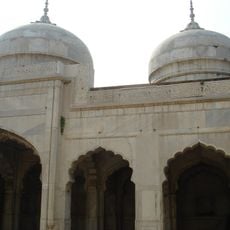
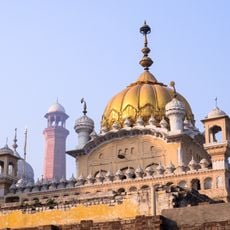
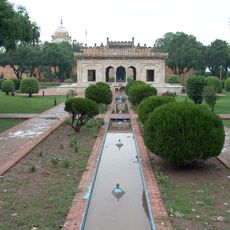
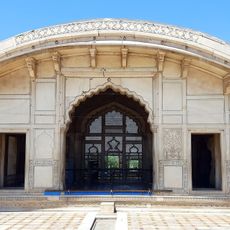
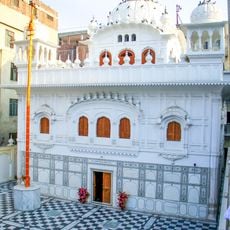
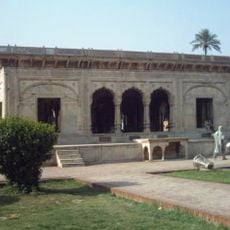
The Samadhi of Ranjit Singh is a white masonry tomb in Lahore's Walled City, next to the Lahore Fort and Badshahi Mosque. A large central onion dome with a tall gold finial rises above smaller white domes, over a facade of small arched openings and a balcony of scalloped arches. Yellow-ochre bands frame the lower arched windows, and a parapet of rounded merlons runs along the base.
Construction began in August 1839 on the cremation site, started by Kharak Singh and delayed by infighting among Sikh factions. Duleep Singh saw it finished in 1848, and after annexation in 1849 the British repaired it by 1851. It was the last major state-funded building project of independent Punjab.
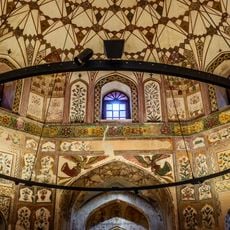
The architecture blends Sikh, Hindu, and Islamic traditions together. At the entrance facade, carved figures of Ganesh, Devi, and Brahma in red sandstone show how different religious imagery comes together in this space.
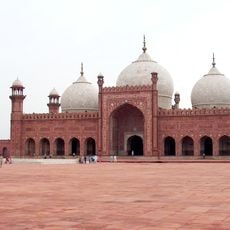
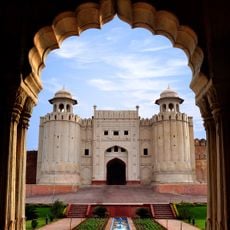
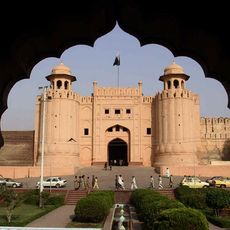
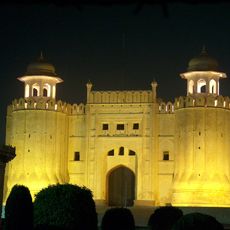
Access is limited to local or visiting Sikhs; other visitors need special permission from the Evacuee Trust Property Board. The samadhi stands inside the Walled City beside the Lahore Fort, Badshahi Mosque and Gurdwara Dera Sahib, overlooking the Hazuri Bagh to its south. Two small monuments to Kharak Singh and Nau Nihal Singh, with their wives, stand west of the main building.
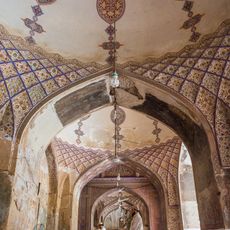
The engineer Kanhaya Lal was hired by the British to save the building from collapse: its eight interior columns could not carry the dome's weight, so he added eight more and clamped cracked marble columns with iron. Nineteenth-century accounts also record a white marble Ganesha at the eastern entrance and Hindu goddess statues inside, none of which can be traced today.
The community of curious travelers
AroundUs brings together thousands of curated places, local tips, and hidden gems, enriched daily by 94,658 contributors worldwide.