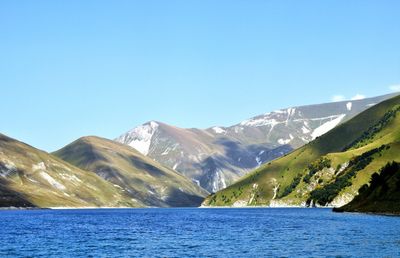
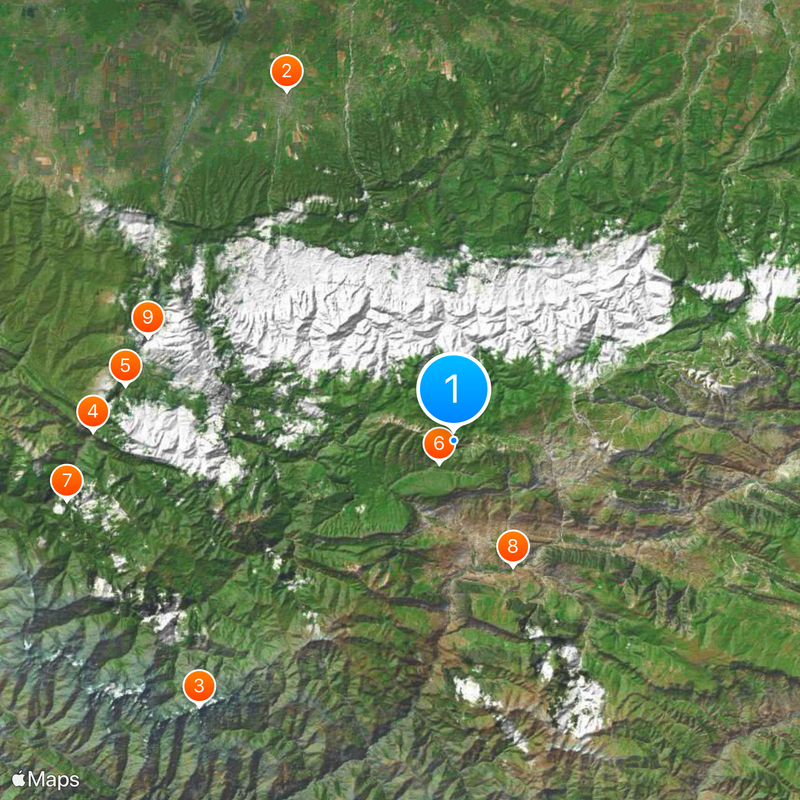
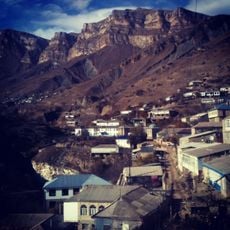
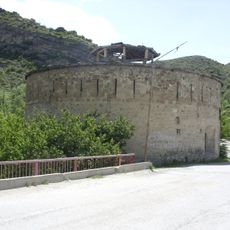
Kezenoyam, Alpine lake at Vedensky and Botlikhsky districts, Russia.
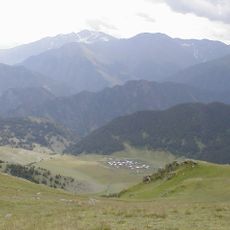
Kezenoyam sits at 1854 meters above sea level on the border between Chechnya and Dagestan, extending nearly three kilometers from west to east. The water reaches depths of up to 74 meters in places, filling a basin framed by forested slopes and mountain ridges.
The lake formed when a landslide from the southern slope of the Kashkerlam ridge dammed the valleys of the Kharzum and Kauka rivers, probably after an earthquake. The natural dam in the western part rises over 100 metres. In 1970–1980 the shore hosted a Soviet Olympic rowing base, destroyed during the Chechen wars. In 2011 Zaur Zakrailov swam the lake's length, about 4.5 km.
Chechen legend says a village named Kezenoy stood here until its people refused hospitality to an angel disguised as a wanderer; the earth opened and the village sank, leaving the lake. The name Kezenoyam recalls that drowned settlement. Russian settlers called it Bolshoye Forelnoye, the big trout lake, because of its abundance of trout.
Swimming is banned and punishable by a 5,000-ruble fine, partly because the cold water poses a drowning risk. The lake surface lies at 1,854–1,870 m, and summer water temperatures reach only 17–18 °C at the surface, dropping to 7–8 °C in deeper layers. Winter ice can be 60–80 cm thick.
The clear water is home to a species of trout found nowhere else on Earth, adapted over thousands of years to the cold conditions. Researchers monitor this population to better understand the ecosystem of isolated high-mountain lakes.
The community of curious travelers
AroundUs brings together thousands of curated places, local tips, and hidden gems, enriched daily by 93,091 contributors worldwide.