Yelagin Palace, Neoclassical palace in Saint Petersburg, Russia
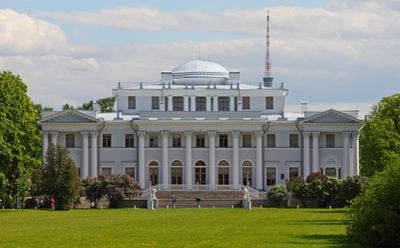
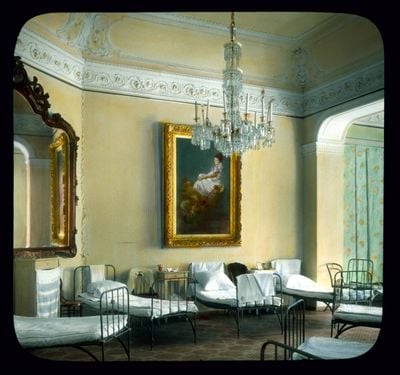
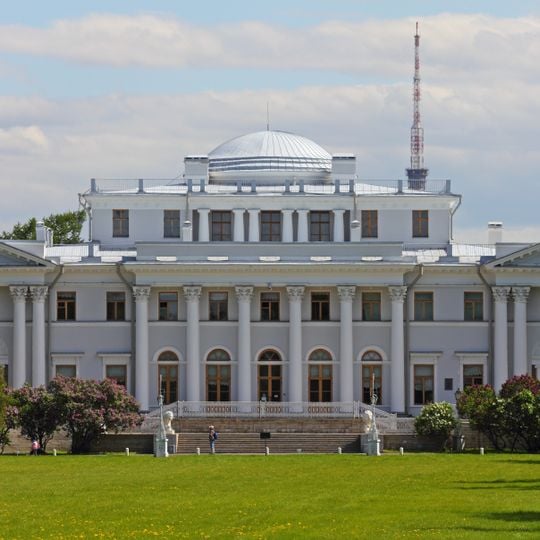
Yelagin Palace is a three-story Palladian villa on Yelagin Island in Saint Petersburg, rebuilt by Carlo Rossi from 1818 and completed in 1822. Its pale gray-blue facade has a white columned portico across the middle level, arched ground-floor windows behind a balustraded terrace, and a ribbed silver-gray dome on a square base. Inside, pale yellow walls carry a white relief molding, and a gilded frame with a portrait of a seated woman hangs beside a glass chandelier.
Emperor Alexander I purchased the estate in 1818 for his mother Maria Feodorovna and commissioned architect Carlo Rossi to redesign the entire palace complex. This reconstruction transformed the site into one of the major architectural projects of that era.
The interior displays collections of art glass, porcelain, embroidery, and metal crafts that represent Russian decorative arts from the 18th and 19th centuries. These objects show the skill and taste of the Russian nobility during that period.
The palace is reached on Yelagin Island, inside the Central Park of Culture and Rest, and the museum entrance is flanked by two lion sculptures modelled on the Medici lions of Florence. The first-floor doors and the restored study of Alexander I on the second floor are the rooms to seek out. The palace closed for large-scale restoration from August 2016 to April 2021, so confirm current opening before travelling.
The palace earned the nickname "palace of doors": Carlo Rossi personally designed more than twenty first-floor doors, each faced with rare woods and finished with gilded carving, and no two share the same decoration. The door to Alexander I's second-floor study was ornamented with bronze. The entrance is guarded by two lions modelled on the Medici lions of Florence.
The community of curious travelers
AroundUs brings together thousands of curated places, local tips, and hidden gems, enriched daily by 93,867 contributors worldwide.