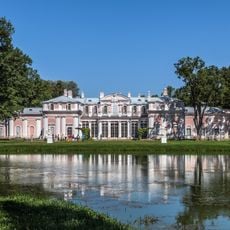
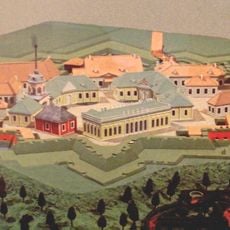
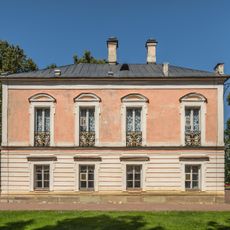
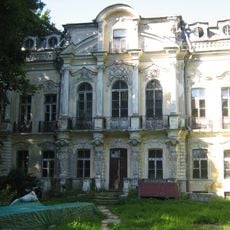
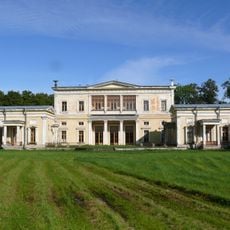
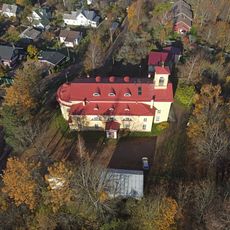
'Kamennoe zalo' pavilion, Concert hall in Oranienbaum, Russia.
The Kamennoe zalo pavilion stands on a natural rise in Oranienbaum Park between the Great Menshikov Palace and the Katalnaya Gorka pavilion. Built in 1749–1751, it began as a stone house with L-shaped wooden wings; its facade is divided by pilasters, topped by a balustrade with vases, and its windows have shaped surrounds and pediments. The apse and west risalit recall its years as a church.
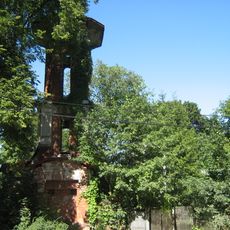
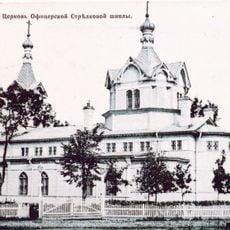
Built between 1749 and 1751, the pavilion's architect is unknown; D. A. Kuchariants suggests M. G. Zemtsov, citing similarities with the Hall of Glorious Celebrations in the Summer Garden. In the 1750s it hosted court festivities for the young court of Grand Duchess Catherine Alexeevna. In 1843, at Elena Pavlovna's request, it was rebuilt as the Lutheran Church of St. Helena; a bell tower added in 1902 was removed in 1967.
In the 1750s Catherine Alexeievna, then Grand Duchess, held court festivities here; for Pyotr Fyodorovich's name day in summer 1757 the cantata "Prophecying Urania" was performed, with words by A. Denzi translated by Mikhail Lomonosov, using his machine of globes and spheres bearing the muse Urania. Today the pavilion hosts classical music concerts in the summer season.
The pavilion sits within Oranienbaum Park and is easily reached by public transport. Visitors should allow sufficient time to explore both the interior and the surrounding park grounds at a comfortable pace.
The building's east apse and west risalit survive from its years as the Lutheran church of St Helena, consecrated here in 1843 at the wish of Grand Duchess Elena Pavlovna. A stone bell tower added in 1902 was demolished in 1967 during restoration.
The community of curious travelers
AroundUs brings together thousands of curated places, local tips, and hidden gems, enriched daily by 94,555 contributors worldwide.