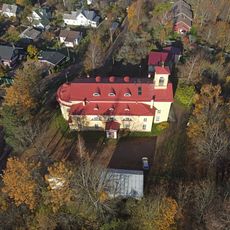
Holy Trinity church, Orthodox church in Petergof, Russia
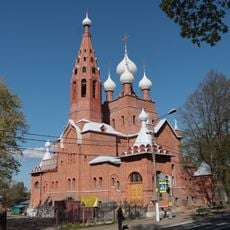
Holy Trinity Church is a single-storey stone church built in 1858–1860 to a design by Andrei Stackenschneider, with a rectangular plan formed by the main volume, apse and narthex. An onion dome sits on an octagonal light drum, and the large windows and modest exterior detailing imitate early 18th-century architecture. The interior was finished under Alexander Bryullov, and a small bell tower on six hollow cast-iron columns once stood apart from the church.
A wooden church dedicated to the Vladimir Icon of the Mother of God stood west of Elizabeth Petrovna's palace by 1748; it was restored in 1797 under the name of the Holy Trinity and dismantled as dilapidated in 1858. On 16 July 1858 protopresbyter Vasily Bazhanov laid the foundation stone of the stone church designed by Andrei Stackenschneider, consecrated by him on 27 July 1860. Closed in 1918, it served as a waiting hall for the nearby Everyday Life Museum, was conserved in the 1970s and returned to the Russian Orthodox Church in 2005.
The church was consecrated in 1860 and served only one liturgy a year, on the feast of the Holy Trinity. Its interior decoration was carried out under the painter Alexander Bryullov, and a mosaic icon of the Mother of God was set into the top board of the analogion. Since 2005 the building has belonged again to the Russian Orthodox Church and is attached to the Church of St Seraphim of Sarov in Stary Petergof.
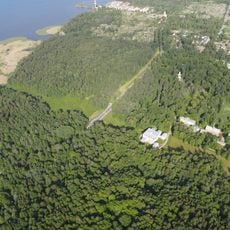
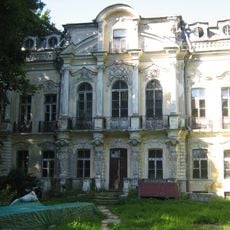
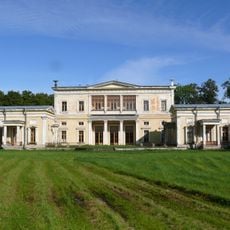
The church stands on the grounds of the former Imperial Own Dacha, next to the palace that housed the Everyday Museum. It is assigned to the Church of St. Seraphim of Sarov in Stary Petergof, and restoration work is ongoing, so access to the interior may be limited.
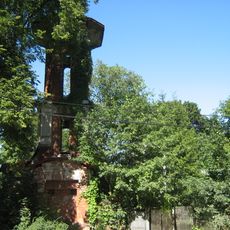
The church is attached to the Church of St Seraphim of Sarov in Stary Petergof, within the St Petersburg Eparchy, not the Kursk Eparchy. Services here were held only once a year, on the feast of the Holy Trinity. A small separate bell tower on six hollow cast-iron columns, designed by Andrey Shtakenshneider and approved on 17 (27) June 1860, has been completely destroyed.
The community of curious travelers
AroundUs brings together thousands of curated places, local tips, and hidden gems, enriched daily by 94,556 contributors worldwide.