English Park, Landscaped park in Petergof, Russia.
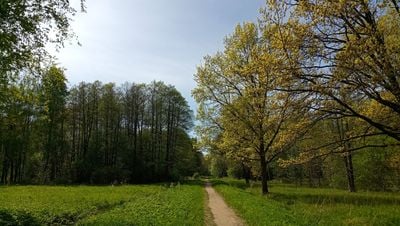
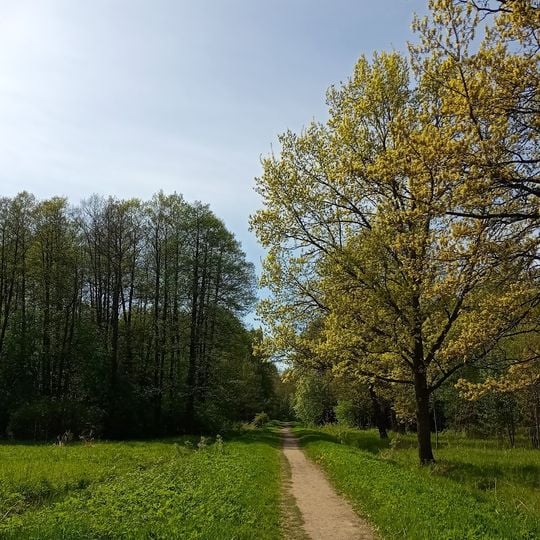
English Park in Petergof is a landscape garden along the Gulf of Finland with open lawns, wooded sections, and scattered water basins. The layout uses natural slopes and terrain variations to create different areas that unfold as you walk through them.
The pond was formed in 1720 by damming Troitsky Creek; in 1734 the wooded land around it was given over to a game preserve where wild boars were kept for hunting. In the 1770s Catherine II had the boar preserve removed and a landscape park laid out, with Giacomo Quarenghi and James Meders using the pond's natural outline as the composition's centre. The English Palace, begun by Quarenghi for Catherine, took 15 years and was finished in 1796; under Paul I it became barracks, and it was destroyed by artillery fire in the war and never rebuilt.
The park's name comes from the English landscape style introduced under Catherine II, who had James Meders and Giacomo Quarenghi lay out the grounds. Its centrepiece, the English Pond, was formed in 1720 by damming the Troitsky Creek. Before the park, the wooded land around the pond held a game enclosure where wild boars were kept for hunting.
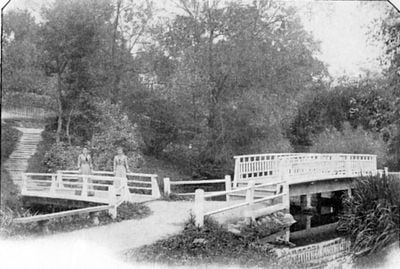
The park lies west of the Lower Park, and its 173.4 hectares are largely semi-derelict, with dense trees and shrubs along the water. The English Pond, fed by the Troitsky Creek, is crossed by footbridges such as the white-railed wooden one in the photograph. Paths are unpaved and can be overgrown, so sturdy footwear helps; the grounds are used for picnics.
The English Pond was formed in 1720 by damming the Troitsky Creek with an earth dam in a large ravine west of the Lower Park. Its water passes through a system of sluices into the Verkhnesadsky Canal and then to the western side of the Grand Cascade. The pond was later linked to the Ropshinsky Canal.
The community of curious travelers
AroundUs brings together thousands of curated places, local tips, and hidden gems, enriched daily by 94,044 contributors worldwide.