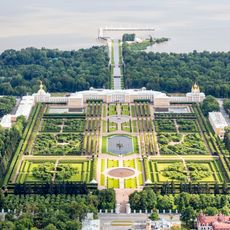
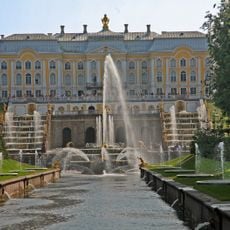
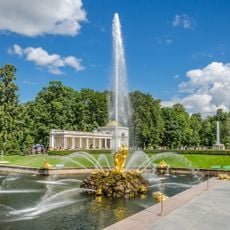
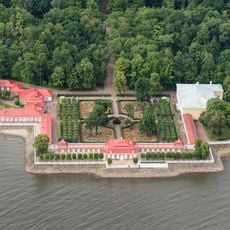
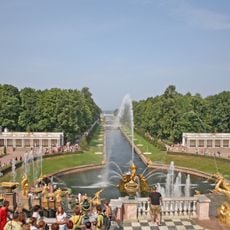
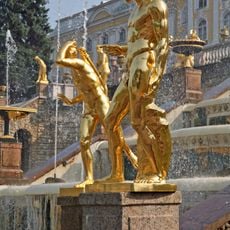
Lion Cascade, Federal cultural heritage fountain in Petergof, Russia.
Lion Cascade is a fountain structure in Petergof supported by 14 gray granite columns arranged in a Greek temple design, with bronze sculptures positioned throughout the water feature. Water flows downward through connected pools and channels, powered entirely by gravity without the need for mechanical pumps.
The cascade was built in 1799–1801 to a design by Andrey Voronikhin, replacing an unrealised earlier scheme by Niccolò Michetti for a 'Moses Cascade'. Marble statues of Hercules and Flora were replaced in spring 1801 by bronze lions modelled by I. P. Prokofiev, which gave the cascade its name. In 1854–1857 A. I. Stackenschneider rebuilt it in late Neoclassical style after the Pudost limestone deteriorated, adding 14 Ionic columns of dark grey Serdobol granite with white Carrara marble capitals. Damaged in World War II, it restarted only in August 2000.
The cascade's name comes from the eight bronze lions cast to models by I. P. Prokofiev, installed in spring 1801 in place of marble statues of Hercules and Flora. They are the only survivors of the original decoration: water still pours from their mouths, while the rest of the structure dates from A. I. Stackenschneider's 1854-1857 rebuild.
The feature is best viewed in daylight to appreciate the sculptural details and water movement fully. Since the fountain sits outdoors, visitors should prepare for changing weather conditions and bring appropriate clothing.
The cascade is the only one in the Lower Park built on a terrace rather than a slope. Of the Voronikhin-era decoration, only the bronze lions by I. P. Prokofiev survive; the marble bowls were moved elsewhere, and one now sits in the Vaza fountain.
The community of curious travelers
AroundUs brings together thousands of curated places, local tips, and hidden gems, enriched daily by 93,207 contributors worldwide.