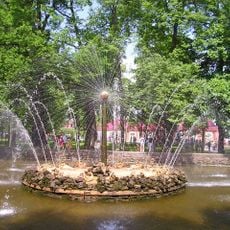
The trick fountains Fir-Trees, Water feature at Peterhof Palace, Russia
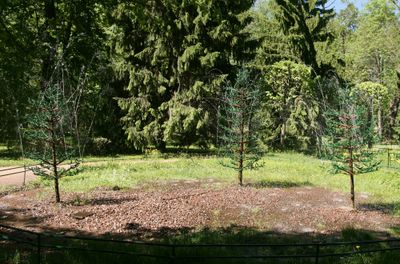
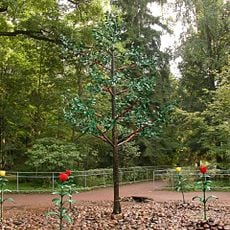
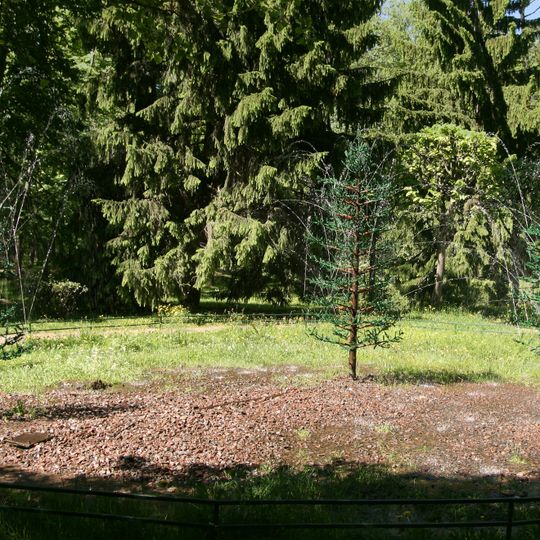
The Fir-Trees fountain in Peterhof's Lower Park is a group of three small metal firs standing near the Orangery, northwest of the Roman fountains off the Marly Alley. Each tree is built from pipes forming a trunk and branches, covered with wire "needles" and painted after an 1828 drawing; from a distance they pass for real firs.
The fountain was created in 1784 during the reign of Catherine II, designed by architect F. A. Strelnikov and built by fountain master I. V. Keizer; some sources name F. P. Brower as architect. Destroyed during World War II, it was recreated in 1949 by architect A. A. Ol and restored in 1958 by a team led by A. Smirnov.
The fountain reflects Russian engineering ingenuity, operating its water system without pumps by relying on natural pressure from elevated reservoirs. This approach allowed it to function reliably across generations.
The fountain stands in the Lower Park near the Orangery, by the Marly Alley and north-west of the Roman Fountains. The three metal firs are easy to mistake for real trees, so watch for the pipes forming trunk and branches. The fountain now runs continuously, so water can spray without warning when you pass close by.
The three metal firs are hollow: water pipes run through the trunk and branches, and the needles are wire painted after an 1828 drawing. From a distance they pass for real spruce trees, which is why guests in festive dress were caught off guard when the water started.
The community of curious travelers
AroundUs brings together thousands of curated places, local tips, and hidden gems, enriched daily by 93,574 contributors worldwide.