Яли-Бахча, Cultural heritage site in Alushta, Crimea.
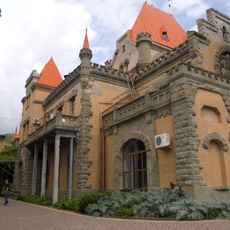
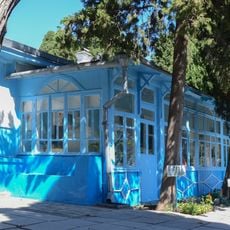
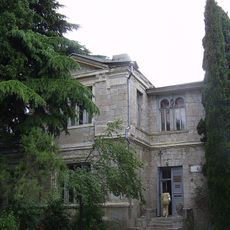
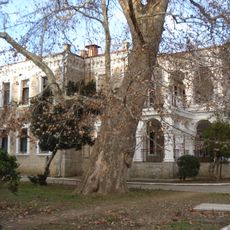
Yali-Bahcha is a three-storey building at 2 Lenin Street in Alushta, the tallest in the city until the late 1940s. Built from 1913, it had 16 shops on the ground floor and 96 rooms above, each with a balcony facing the mountains and the sea. A factory-scaled dome crowns the roof.
The city bought the Ely-Bakhcha orchard in June 1913 for 129,000 roubles and began a three-storey hotel in 1913, the tallest building in Alushta until the late 1940s. Already in 1914 the unfinished building housed a hospital for soldiers; from 1915 the Union of Towns rented it for 15,000 roubles a year. After 1917 it held a gymnasium, the Alushta Soviet, the town's first museum and literary evenings. It was listed as an architectural monument by the Crimean Oblast Executive Committee on 20 February 1990.
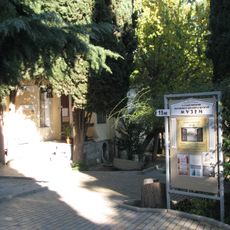
The name Yali-Bahcha comes from Turkic words meaning "garden by the sea", given to the orchard bought with the plot in 1913; a sign reading "Eldorado" was hung on its gate. From 10 June 1914 the 52nd Vilna Infantry Regiment's band played in the garden. After 1917 the building housed Alushta's first museum and library, and Ivan Shmelyov's "The Unquenchable Cup" was first read aloud here.
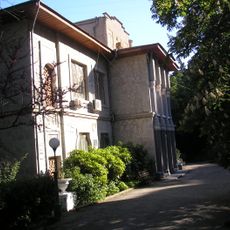
The building stands at 2 Lenin Street, on level ground in central Alushta, not on a hillside. It is a local architectural monument, listed by the Crimean Oblast Executive Committee on 20 February 1990. The 1950s reconstruction added columns, open balconies and sea-facing verandas for climate treatment.
The building's roof dome was covered with factory-made shingles by contractor Ya. M. Chumachenko, while the parquet floors in rooms and corridors were laid by carpenter L. F. Kharitonov. Its heating system followed the design of Professor S. D. Lukashevich, who also created the heating for the Massandra Palace, and the stoves could retain heat for 36 hours.
The community of curious travelers
AroundUs brings together thousands of curated places, local tips, and hidden gems, enriched daily by 93,122 contributors worldwide.