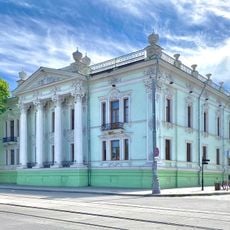
Ტაგანროგის ისტორიულ-მხარეთმცოდნეობითი მუზეუმი, Historical museum in Taganrog, Russia.
The Taganrog Museum of Local History occupies the Alferaki Palace, a building from 1848 designed by architect Andrei Stackenschneider. Its 15 halls hold collections of archaeology, metalwork, weapons, ceramics, glass, textiles, painting, sculpture and numismatics, including a gilded bronze Buddha from Japan, China and India.
The museum was created at the end of the 19th century on the initiative of Anton Chekhov. In 1902, at his request, the Imperial Academy of Arts sent eight paintings by Russian artists, including works by Fedders, Vasilkovsky and Shtemberg; Chekhov also donated his own belongings and a portrait of Leo Tolstoy with a facsimile signature. In 1927 the museum moved into the Alferaki Palace, built in 1848 to a design by Andrei Stackenschneider.
The museum's name comes from its focus on local history, and its setting is the 1848 Alferaki Palace, long the city's cultural centre. Its halls host concerts and gatherings, and Anton Chekhov attended a concert here with pianist and composer Sergei Taneyev and violinist Leopold Auer; Pyotr Tchaikovsky visited the club. Chekhov set scenes of "Ionych", "The Mask" and "My Life" in the palace and its garden.
The museum occupies the Alferaki Palace at Frunze Street 41, and its 15 halls are spread over two floors, so allow time to move between the ethnographic, archaeology and metalwork sections. The building was restored between 1989 and 1996, and the present display was installed in 1995–1996. Look for the corridor-system wing beside the palace, built for the Alferaki sons and their tutors.
The largest item in the museum's Oriental collection is a gilded bronze Buddha seated in the lotus position on a lotus throne. Much of this collection came from General P. K. Rennenkampff, who lived in Taganrog under the name F. Smokovnikov and was shot in 1918.
The community of curious travelers
AroundUs brings together thousands of curated places, local tips, and hidden gems, enriched daily by 93,179 contributors worldwide.