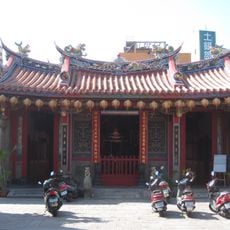
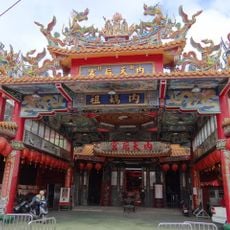
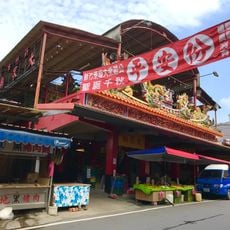
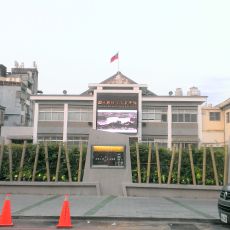
Hsinchu City God Temple, Religious temple in North District, Hsinchu City, Taiwan.
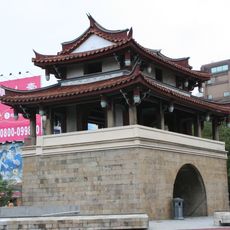
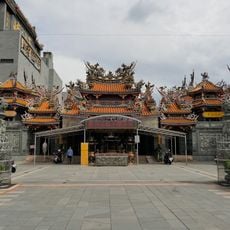
Hsinchu City God Temple is a religious temple in the north of the city, built with six main halls: the Bell and Drum Tower, Main Hall, Back Hall, Horenji, Sanchuan Hall, and Protection Room. These spaces are arranged to guide visitors through different functional areas of the temple.
Built in 1748 as an official temple after Tongzhi Zeng Riying's petition, on land donated by settler Wang Shijie, whose spirit tablet is still honoured. In 1875, when Taipei Prefecture was provisionally seated at Hsinchu, the City God was raised from county rank to the prefectural title Suijing Hou. In 1890 the court approved a rite at the temple, and the Guangxu Emperor bestowed the plaque reading "Golden Gate Protection", elevating the deity to provincial City God.
Every year on the 29th day of the eleventh lunar month, the City God's birthday draws worshippers from branch temples in Taichung, Dajia, Taitung and Pingtung. During the seventh-month Ghost Festival, the temple opens the Tiger Gate on the first day, and on the fifteenth the City God parades through the streets to relieve the lonely spirits. At the Zheng family shrine he rests for tea and bird's-nest soup served on a bed of eggs, a custom called "Zheng cuo gong yan".
The temple stands at No. 75 Zhongshan Road in Zhongshan Village, North District. Worshippers normally follow a four-hall, five-incense-burner order: the Heaven burner and City God burner in the main hall, then Guanyin's burner at Falian Temple, the Maitreya burner behind it, and the City God's wife's burner in the rear hall. The Falian Temple is screened by the temple courtyard and hard to make out.
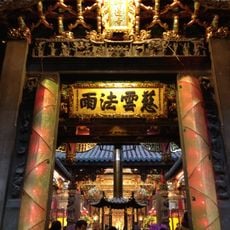
The temple's name plaques carry a political history: the "Golden Gate Protection" board above the main hall is attributed to the Guangxu Emperor, awarded after a 1890 ceremony, while the "理陰贊陽" plaque was donated by Zheng Yongxi, Taiwan's first jinshi. The front stone lions, carved from Quanzhou Qingdou stone, turned dark green through oxidation and appeared on a 1993 postage stamp.
The community of curious travelers
AroundUs brings together thousands of curated places, local tips, and hidden gems, enriched daily by 94,703 contributors worldwide.