Agueda Dam, Dam in the province of Salamanca, Spain
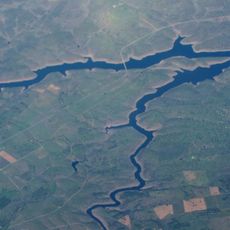
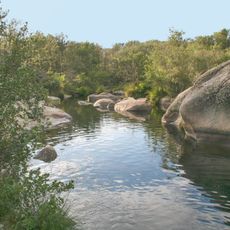
Agueda Dam is a concrete structure in Salamanca province that holds back the Agueda River to form a large reservoir. The construction stretches about 196 meters across and rises roughly 37 meters above the water surface.
The dam was completed in 1931 and was built to regulate the Agueda River for irrigation and flood control in the region. This construction marked a period when infrastructure was developed to protect communities from flooding and secure water supply.
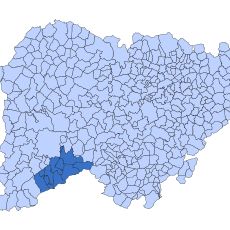
The dam takes its name from the Águeda River, a tributary of the Duero. Its water is used to irrigate the vega of Ciudad Rodrigo, about 10 km downstream to the north, so the fields around that town depend on the reservoir. The dam stands between the municipalities of Zamarra and Pastores.
The dam lies between the municipalities of Zamarra and Pastores, about 10 km south of Ciudad Rodrigo, which it was built to irrigate. The reservoir is formed by the Águeda, a tributary of the Duero. The crest is 195.70 m long, so the crossing on foot takes only a few minutes.
The dam is built of cyclopean concrete, a mix in which large stones are embedded in the concrete mass. It was inaugurated by King Alfonso XIII, and in 1992 a hydroelectric plant was completed at the foot of the dam. The reservoir holds up to 22 hm³.
The community of curious travelers
AroundUs brings together thousands of curated places, local tips, and hidden gems, enriched daily by 95,192 contributors worldwide.