Palacio de Montarco, Ciudad Rodrigo, Renaissance mansion in Ciudad Rodrigo, Spain
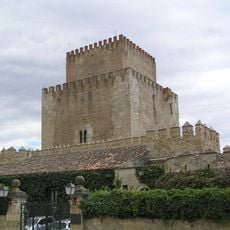
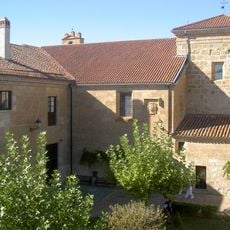
Palacio de Montarco is a stone ashlar palace begun in 1499 in Ciudad Rodrigo, transitional between Gothic and Plateresque. Its facade has a lintel doorway with Gothic bases, an alfiz, twisted columns topped by lions, and a large central carved coat of arms. It was conceived as a family residence rather than a fortress, and its four outer walls stand free.
Built in 1499 by city mayor Francisco Hernández de Ávila y Tiedra, the palace reflects early Renaissance architecture and noble power in the region. It later served as a military headquarters during the French siege of 1810.
The central coat of arms on the doorway is carved in three quarters: castles and a lion for the Enríquez lineage, a lion with a star and fleur-de-lis for the Núñez de Ciudad Rodrigo, and five faces beneath a helmet for the Caraveo. Stars and fleurs-de-lis also decorate some of the palace windows.
The palace stands on the Plazuela de San Isidoro, today called Plaza del Conde, a few metres from the cathedral, and its four exterior walls are free-standing, so it can be seen from the square on its entrance side by the Puerta del Conde. It is privately owned and was sold to its current owners in 2006, so it is viewed from the street rather than visited inside.
The palace was conceived as a casa-palacio, combining a noble residence and family home rather than the defensive character usual in its era, an architectural novelty in Spain. Its four exterior walls stand free, so the carved facade can be seen in full from the Plazuela del Conde.
The community of curious travelers
AroundUs brings together thousands of curated places, local tips, and hidden gems, enriched daily by 95,293 contributors worldwide.