Arco de Ladrillo, Valladolid, Brick railway arch in Valladolid, Spain
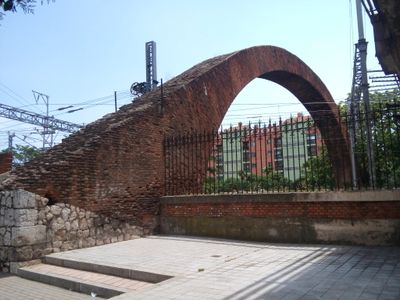
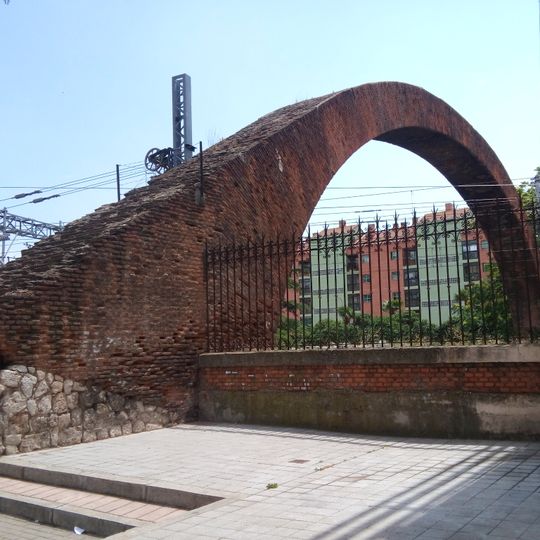
The Arco de Ladrillo is a brick arch spanning the Madrid railway line in Valladolid, built entirely from clay bricks. The structure features a curved design supported by solid foundations on both sides.
Built in 1856, before the Madrid–Hendaye tracks were laid, the arch is considered Valladolid's first railway structure. Its origin is debated: it is attributed to Julián Sánchez as a model for tunnel-mouth arches for the Compañía de los Caminos de Hierro del Norte de España, to the engineer Venancio del Valle, or, most plausibly, to Joaquín Fernández Gamboa, who built it to show the strength of the bricks from his factory. A planned burial of the railway line once threatened it with dismantling and relocation; the project's cancellation secured its survival.
The name Arco de Ladrillo means "brick arch", after the 147,276 solid bricks that make up the structure, of which 34,680 are visible, each measuring 22.2 cm long, 14 cm wide and 5 cm high. The arch has no known practical use and may have been built as a display piece in the rivalry between iron and brick at the end of the 19th century.
The arch crosses the Madrid–Hendaye tracks next to Valladolid-Campo Grande station, so it is seen from the surrounding streets and from the platforms rather than approached on foot. The two abutments are not symmetrical: one is 6.50 m wide and 2.60 m high, the other 6.62 m wide and 1.71 m high. The upper face of the abutments is rendered, probably to improve waterproofing.
The arched shape creates an unusual acoustic property where sound travels and reflects in unexpected ways. This makes it an interesting place to experience how architecture affects sound.
The community of curious travelers
AroundUs brings together thousands of curated places, local tips, and hidden gems, enriched daily by 94,366 contributors worldwide.