Cueva de Bolomor, Archaeological site in Tavernes de la Valldigna, Spain.
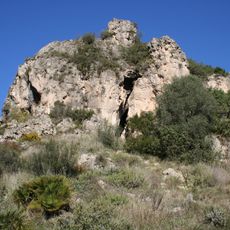
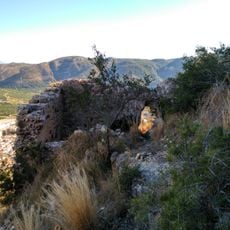
Cueva de Bolomor is a karst rock shelter on the right side of a cliff in the Barranco de Bolomor, 2 km southeast of Tavernes de la Valldigna and 100 m above sea level. Its dome collapsed, probably from seismic activity, leaving a shelter about 35 m long, 17 m wide and 20 m deep with an irregular interior. The mouth overhangs the valley and looks toward the coast and Cullera.
Occupation of the cave is dated between 350,000 and 120,000 years ago, with three main phases recognised: around 350,000, 200,000 to 150,000, and 120,000 years ago. The first written account dates from the early 1860s, when neighbours from Tavernes searched inside for treasure. Juan Vilanova i Piera and Eduardo Boscá explored it in 1867, and annual excavation has continued since 1989 under Josep Fernández Peris and Pere Guillem Calatayud.
The cave takes its name from the Bolomor gully where it opens, 2 km southeast of Tavernes de la Valldigna. Excavations since 1989 have uncovered fifteen hearths between 250,000 and 100,000 years old, some lined with stone, and rabbit bones bearing cut marks, evidence of small-game trapping rare for the Middle Pleistocene.
The cave lies 2 km southeast of Tavernes de la Valldigna, on the right side of a cliff at 100 m above sea level, reached by a steep slope. Excavations run annually since 1989 for 30 days, so access may be restricted during campaigns. The interior is irregular and unlit; bring a torch and sturdy footwear.
Cut marks on rabbit bones are unusually frequent for the Middle Pleistocene, when such small, quick prey was rarely taken. Carrying any kill, including young elephants, up the 100-metre slope to the shelter was itself part of the effort.
The community of curious travelers
AroundUs brings together thousands of curated places, local tips, and hidden gems, enriched daily by 93,467 contributors worldwide.