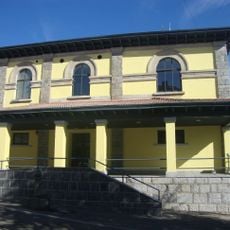
La Quinta, Neoclassical palace in El Pito, Cudillero, Spain
La Quinta de Selgas is a palace and walled estate in El Pito, in the Cudillero municipality of Asturias. The rectangular mansion has a ground floor, two upper floors and an attic, its central bay set slightly forward above a stone stairway to the garden. From the south triumphal-arch gate runs a long French garden of aligned statues and geometric lawns and flower beds.
Ezequiel de Selgas, a Madrid businessman, funded the project, while his brother Fortunato, a historian and art lover, drew up the historicist design. The palace and gardens were built between 1880 and 1895 in El Pito, in the municipality of Cudillero. Fortunato acquired the future Goya painting without knowing its author; the attribution was discovered in 1993 by Jesús Urrea.
The Selgas brothers' monogram, an S, appears on commissioned pieces such as the stained-glass window above the main staircase and the upholstery of the ballroom seats. The ballroom, the house's most opulent space, has doors lined with mirrors and walls shaped by gilded boiseries. A bedspread given to the Selgas family by Queen Isabella II is among the keepsakes on display.
The estate is enclosed by a perimeter wall with two monumental gates: the main one to the south, shaped like a triumphal arch, and a side gate crowned by two winged lions. From the main gate a long French garden leads toward the palace, using aligned statues and geometric lawns to frame the view. The palace, the tapestry pavilion and the nine hectares of gardens are visited on guided tours.
Two monumental gates mark the entrance to the estate, with the main gate forming a triumphal arch. This architectural element gives visitors an impression of grandeur right from the approach to the property.
The community of curious travelers
AroundUs brings together thousands of curated places, local tips, and hidden gems, enriched daily by 93,686 contributors worldwide.