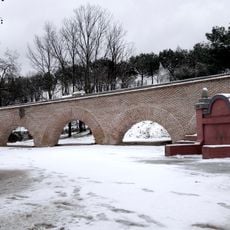
Galería de las Grutas, Renaissance pavilion in Casa de Campo, Madrid, Spain
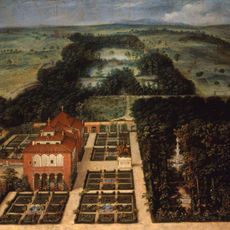
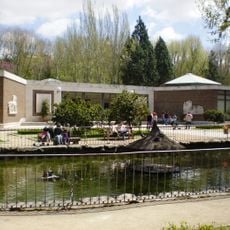
The Galería de las Grutas, also called La Lonja or Grutas de Felipe II, is a Renaissance pavilion built into a slope in Casa de Campo. It is a rectangular structure about 30 m wide and over 7 m high, with a double-apsed plan and five vaulted bays: the two outer bays rest on pillars, the three central ones on Tuscan columns. Its eastern face opens onto the gardens through five large lowered-arch doorways, while the western side is buried in the earth like a cave. It is partly preserved and in poor condition, now covered by a wooden roof.
Construction began in 1567, five years after Philip II acquired the Casa de Campo de los Vargas and laid out gardens, woods and orchards following a landscape plan by Juan Bautista de Toledo, who may also have designed the grottoes. Italian engineers and artists took part: Juan Antonio Sormano and Juan Bautista Bonanome handled the ornamentation, Jerónimo Carruba the interior fountains. In the 18th century houses for guards and gardeners were built on the roofs; José I Bonaparte had them demolished after 1808. Part of the gallery later collapsed, and in 1876 José Segundo de Lema built a guard post on its southern remains.
Each vaulted bay had its own name and theme. The Sala de Burlas took its name from a fountain with hidden jets operated from a distance to soak unsuspecting visitors, a practical joke recorded in the sources. The Sala del Mosaico refers to mosaics made of brick and glass fragments, and the Gruta de Neptuno appears under that name on Pedro Teixeira's 1656 map of Madrid.
The pavilion sits within Casa de Campo park and can be accessed through various park entrances, with the Casa de Campo metro station nearby for public transport access. The best visiting time is during cooler hours, and comfortable walking shoes are helpful since the building requires a walk through the park grounds.
The interior was decorated with corals, shells, conches and turtle shells set into stucco, with hidden water pipes feeding springs and jets. One room, the Sala de Burlas, had concealed spouts operated from a distance to soak unsuspecting visitors. A coral fountain by the Sicilian artist Nicolás de Aragona is documented.
The community of curious travelers
AroundUs brings together thousands of curated places, local tips, and hidden gems, enriched daily by 93,592 contributors worldwide.