Niujie Mosque, Islamic mosque in Niujie district, Beijing, China
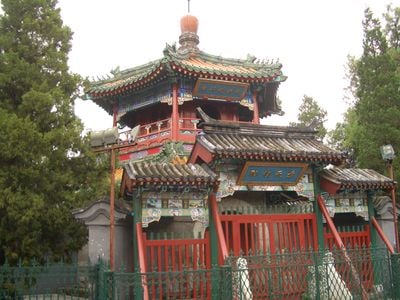
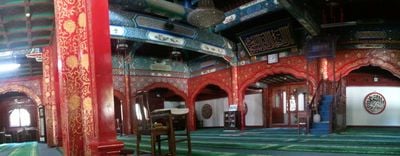
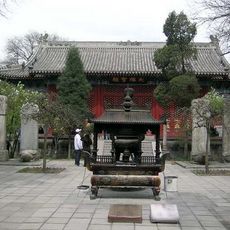
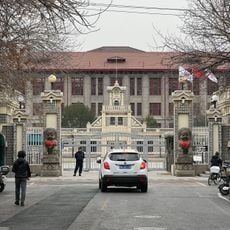
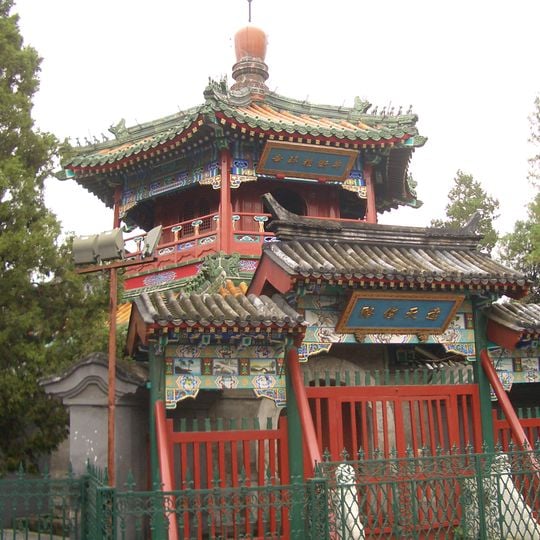
Niujie Mosque is a timber mosque in Beijing's Xicheng District, built on a traditional Chinese courtyard plan. Its entrance is the two-storey, hexagonal Wangyue Tower, with green glazed eaves and a blue plaque reading "Niujie Libaisi"; behind it the prayer hall's three connected roofs cover 760 square metres, and its western niche (mihrab) retains Liao-dynasty woodwork.
The Niujie Mosque was first built in 996 during the Liao dynasty, not the Northern Song, and was designed by Nazaruddin, son of an imam. After its destruction by Genghis Khan's armies in 1215, it was rebuilt in 1443 under the Ming, and the Chenghua Emperor gave it the name Libaisi in 1474. It was significantly expanded in 1696 under the Kangxi Emperor of the Qing dynasty.
The mosque serves as a gathering place for Muslims in Beijing, where daily prayers happen and the community comes together during special times like Ramadan. It shapes neighborhood life as a center where faith and community are lived out.
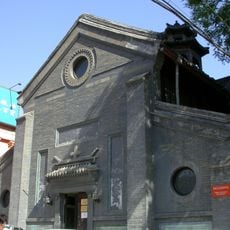
The mosque sits on Niujie street in Xicheng District, a short walk southwest of Caishikou Station on the Beijing Subway. The everyday entrance is the south gate, where the ticket office is; the main Wangyue Tower gate opens only on festivals such as Eid al-Fitr and Eid al-Adha. Non-Muslims may not enter the prayer hall, but staff are willing to talk with visitors who speak Chinese. The China Islamic Institute lies just southeast, at Nanheng W. Road and Jiaozi Hutong.
The building blends traditional Chinese wooden structures with Arabic decorative patterns, showing a rare mixing of two cultures. On the walls and columns you can see inscriptions in Chinese and Arabic script side by side.
The community of curious travelers
AroundUs brings together thousands of curated places, local tips, and hidden gems, enriched daily by 93,121 contributors worldwide.