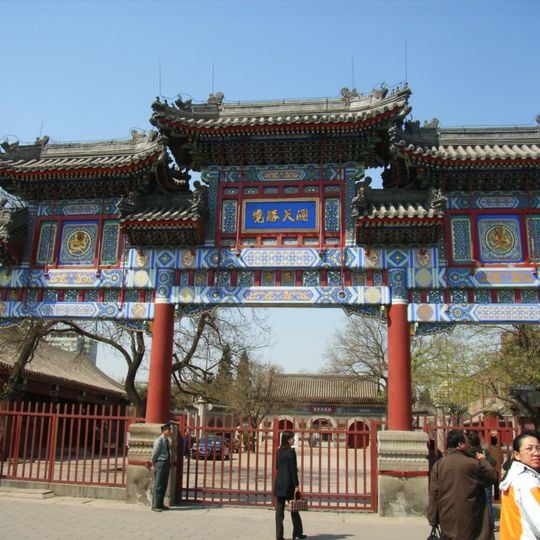
White Cloud Temple, Taoist temple in Xicheng District, Beijing, China.
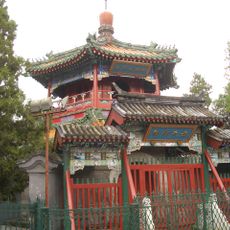
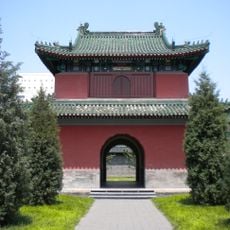
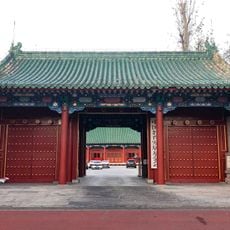
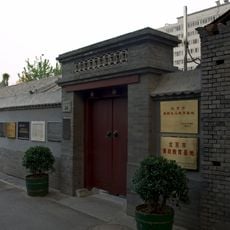
The White Cloud Temple is a Taoist temple and monastery laid out on a north-south axis, entered from the south. Five main halls stand along the axis: the Main Gate, Yuhuang Hall, Laolü Hall, Qiuzu Hall and Sanqing Hall. Two smaller side axes hold halls to various deities, and a rear garden contains the ordination platform.
Founded in 741 during the Tang dynasty as the Temple of Heavenly Perpetuity (Tianchang Guan), the site became the Quanzhen headquarters after Qiu Chuji took it over in 1215 and renamed it the Palace of Eternal Spring. His successor Yin Zhiping built a shrine over Qiu's grave in 1228, which grew into the White Cloud Temple. The Ming destroyed the Palace of Eternal Spring, but the White Cloud Temple survived and absorbed its functions.
The temple's name comes from the shrine built over Qiu Chuji's grave by his successor Yin Zhiping. Every year on the 19th day of the first lunar month, a festival marks Qiu's birthday, first held in the Yuan dynasty, suspended after 1949 and revived in the 1990s. The abbey is the seat of the Chinese Taoist Association.
The grounds are walkable and the pathways are clearly marked, making it easy for visitors to navigate the different areas. Most routes involve level walking or gentle slopes, ensuring access for people with varying mobility needs.
Three stone monkeys are carved at different spots in the temple, and because they are apart, locals say "the three monkeys never meet." Touching them is a folk custom; one sits on the arch of the main gate, another on the side screen wall, and a third on the base of a stele by the Wofeng Bridge.
The community of curious travelers
AroundUs brings together thousands of curated places, local tips, and hidden gems, enriched daily by 93,082 contributors worldwide.