Changchun Temple, Buddhist temple in Xicheng District, Beijing, China
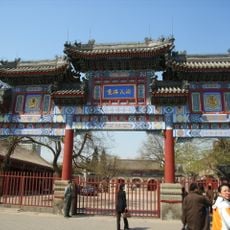
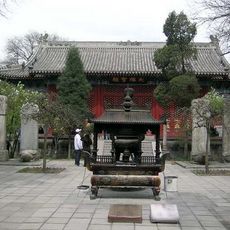
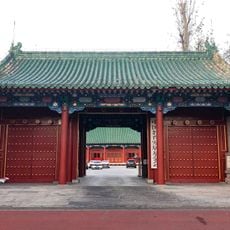
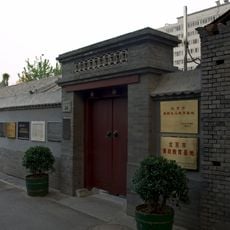
Changchun Temple is a Buddhist temple at 9 Changchun Jie in Xicheng District, Beijing, built in 1592 and now housing the Beijing Xuannan Cultural Museum. It faces east and retains four successive courtyards: the gate hall, the Hall of Heavenly Kings, the Mahavira Hall and the sutra library. The gate plaque reads "imperially built Changchun Temple", and two old locust trees remain of the eight that once stood before it.
The temple was built in 1592 on the order of Empress Dowager Xiaoding Li, mother of the Wanli Emperor, to house the monk Shuizhai, and the emperor gave it the name Changchun. Damaged by the 1679 Sanhe-Pinggu earthquake, it was rebuilt in 1681 with a donation from the minister Feng Pu, and repaired again in 1755. It later stored coffins, became housing after 1949, and reopened in 2005 as the Xuannan Culture Museum.
The temple's name, bestowed by the Wanli Emperor, means "long-lasting ailanthus" and was chosen to wish his mother, Lady Li, a long life. Since 2005 the halls have housed the Xuannan Culture Museum, whose eight galleries cover Xuannan scholars, opera, commerce and local history. Two old locust trees remain of the eight that once stood before the gate, known as the "eight locusts guarding the gate".
The temple faces east at 9 Changchun Jie, entered through a gate whose plaque reads "敕建长椿寺". It now holds the Xuannan Culture Museum, with eight exhibition halls across four successive courtyards, so allow time to walk from the gate through the Hall of Heavenly Kings and the Mahavira Hall to the sutra library. A small garden, Changchun Yuan, was added to the south.
The temple's name, bestowed by the Wanli Emperor, means "long-lasting ailanthus" and was chosen to wish his mother, who founded the temple, a long life. The ailanthus (chun) tree is a symbol of longevity in Chinese culture.
The community of curious travelers
AroundUs brings together thousands of curated places, local tips, and hidden gems, enriched daily by 94,302 contributors worldwide.