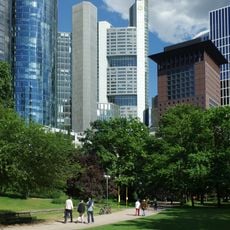
Opernplatz, Central square in Bankenviertel, Frankfurt, Germany.
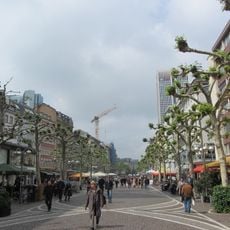
Opernplatz sits in front of the Old Opera House and is bordered by seven streets, including the luxury shopping destination Goethestraße and the restaurant-lined Große Bockenheimer Straße. The square features paved areas, seating zones, and tree-lined green spaces for pedestrians.
The site was once occupied by the Bockenheimer Tor, a gate in Frankfurt's medieval city walls, through which the Bockenheimer Landstraße led toward Bockenheim. After the walls were demolished, city architect Johann Georg Christian Hess built a classicist portal there, which was torn down in 1875 to make way for the opera house. The Alte Oper, completed in 1880, was one of the largest opera houses of its time; heavily damaged in World War II air raids, it reopened in 1981 as a concert hall.
The square takes its name from the Alte Oper, the 1880 opera house that was rebuilt and reopened as a concert hall in 1981. Seven streets meet here, among them the Goethestraße, one of Germany's most exclusive shopping streets, and the Große Bockenheimer Straße, known as Freßgass. The Opera Quarter with its luxury shops lies to the east.
The square is easily accessible from the Hauptwache U-Bahn station to the Alte Oper station, with nearby underground parking available. Visitors should note that during events the space fills quickly and seating options may be limited.
The Lucae Fountain on the square was designed in 1872 by architect Richard Lucae for the Rahmhof, but only cast in 1983 by sculptor Edwin Hüller. Its basin of 120 tonnes of yellow Reinersreuther granite measures 17 m across, the bowl 5 m, and it was inaugurated on 14 June 1983 with a citizens' festival.
The community of curious travelers
AroundUs brings together thousands of curated places, local tips, and hidden gems, enriched daily by 94,388 contributors worldwide.