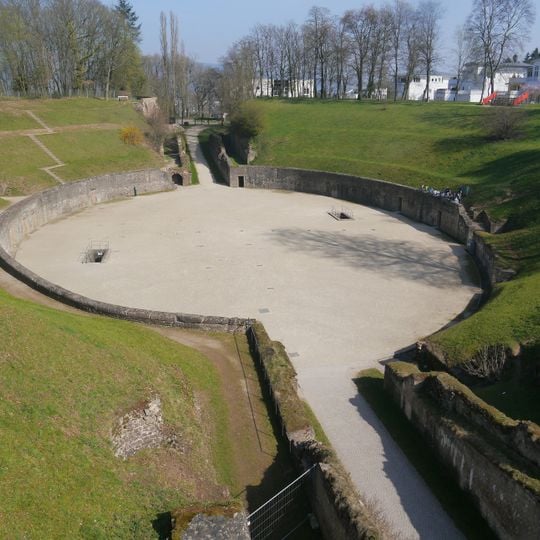
Roman amphitheatre of Trier, Roman amphitheatre in Trier, Germany
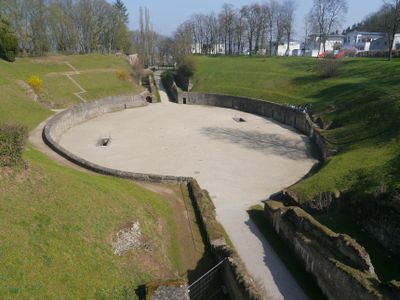
The Roman amphitheatre of Trier is an ancient performance venue with stone seating tiers, subterranean chambers, and multiple passageways originally designed for around 20,000 spectators. The ruins still display the distinctive oval-shaped arena, with underground structures preserved beneath the floor level.
Built in the 2nd century AD, likely under Antoninus Pius, the amphitheatre was dug into the slope of the Petrisberg and incorporated into Trier's Roman city wall, also serving as the eastern city gate. Constantius Chlorus renovated it around 293. It remained in use until the 5th century, then was quarried for stone in the Middle Ages.
Locals called the site "Kaskeller" until the 19th century, a name recorded on city maps and likely referring to the underground rooms used as storage cellars. In summer, an actor playing the gladiator Valerius tells of his career during guided tours. Until 2012, the annual August festival "Brot & Spiele" reenacted Roman games here.
The arena is oriented north-south, with exits at both ends; the dark opening at the lower edge leads into the preserved cellar beneath the arena floor. A small model for blind visitors stands at the entrance. Summer guided tours feature an actor playing the gladiator Valerius.
The arena could not be flooded for mock sea battles because a cellar with lifts lay beneath the floor. Wood remnants and 1,200 coins from the late 3rd century found there suggest the cellar and galleries were added after the original amphitheatre. In 1996 a small burial ground with 46 graves was discovered on the eastern bank.
The community of curious travelers
AroundUs brings together thousands of curated places, local tips, and hidden gems, enriched daily by 93,258 contributors worldwide.