Organs in the Aula Palatina, Pipe organ in Aula Palatina, Trier, Germany
The Aula Palatina holds two organs. The main organ, built by Eule of Bautzen and installed in 2014, has 82 registers and 6,006 pipes, making it the largest organ in Trier. Its roughly 50-tonne weight is divided among three cases hung at the rear wall, set in front of or within the window niches. The 1962 Schuke choir organ, with 30 registers on two manuals and pedal, fills a window niche on the east wall to the right of the altar.
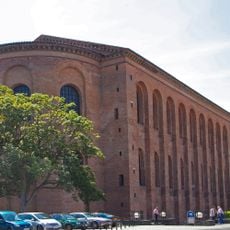
The Aula Palatina was built in 310 AD under Emperor Constantine as a throne room and served for centuries as the most important administrative building in Trier. The current pipe organ was installed in 2014, adding a modern musical dimension to a space that once housed imperial authority.
Since 1999 the basilica's organist has been cantor Martin Bambauer, a former pupil of Daniel Roth. The Caspar Olevian Hall adjoining the church holds a Van Vulpen organ built in Utrecht in 1971. The 2014 Eule organ has a second, mobile console so it can be played from the nave or the choir.
The best way to hear the instrument is to visit during Sunday worship services or scheduled concert events, with times announced at the entrance. Visitors should check ahead or look at the information board to confirm that music will be played during your planned visit.
The 2014 Eule organ weighs about 50 tonnes and is split into three bodies hung on the rear wall, set in front of or inside the window niches, so it projects only slightly into the hall. Its fourth manual controls two separate divisions: an expressive orchestral work with English-romantic colours and a non-expressive solo work with high-pressure stops such as a Tuba imperialis. A second, mobile console lets organists play from the nave or the choir.
The community of curious travelers
AroundUs brings together thousands of curated places, local tips, and hidden gems, enriched daily by 92,644 contributors worldwide.