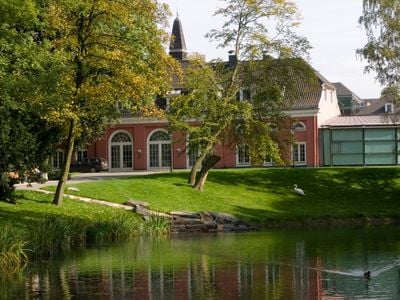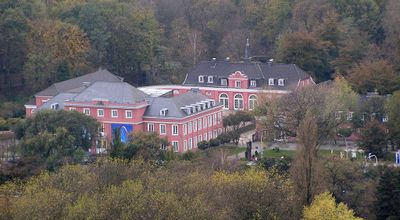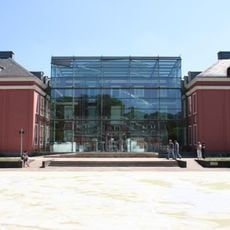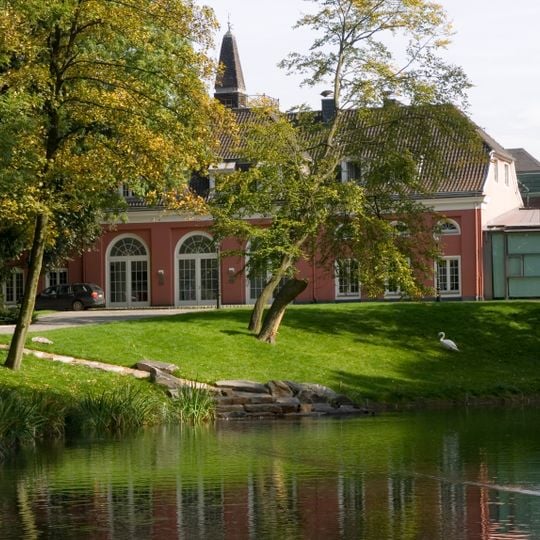
Schloss Oberhausen, Castle with pink facade in Oberhausen, Germany.
Schloss Oberhausen is a neoclassical castle in North Rhine-Westphalia featuring symmetrical wings extending from its central building, with a distinctive pink exterior. The structure contains multiple exhibition galleries and serves as a museum dedicated to visual arts and cultural collections.
A 12th/13th-century predecessor stood about 200 m away and has vanished. After passing from the von Dücker family to the von der Hovens and then the von Boenens, a new Schloss was built between 1804 and 1818 to plans by August Reinking for Count Maximilian Friedrich von Westerholt-Gysenberg. Badly damaged in World War II, the manor house was rebuilt in 1958/59 from the original plans.
The museum is named Ludwiggalerie after Peter Ludwig, the industrialist who in 1983 gave it over 500 works, mainly by East German painters such as Wolfgang Mattheuer and Werner Tübke. Since 1996 it has run three separate galleries: the Ludwig Gallery, a Popular Gallery for posters, comics and photographs, and a Gallery of Signs and Landmarks of the Ruhr. A painting school for children and young people has also worked in the castle since 1977.
The building is centrally located in Oberhausen and easily accessible; visitors should check opening times in advance as these may vary by season and special exhibitions. The interior spans multiple levels, so visitors should allow adequate time for viewing the galleries at a comfortable pace.
In 1983 the collector Peter Ludwig gave the museum over 500 works, mainly paintings by East German artists such as Wolfgang Mattheuer and Werner Tübke, which started the Ludwig Institute for Art. In 1996 he and his wife Irene proposed abandoning a permanent display in favour of rotating exhibitions, leading to three separate galleries.
The community of curious travelers
AroundUs brings together thousands of curated places, local tips, and hidden gems, enriched daily by 94,783 contributors worldwide.