Pompey's Pillar, Roman victory column in Alexandria, Egypt
Pompey's Pillar is a Roman victory column in Alexandria, Egypt. Its single monolithic shaft of pink granite from Aswan rises 20.46 m, with a base and capital bringing the total height to 26.85 m. The shaft is 2.71 m in diameter at its base and weighs about 285 tonnes. It originally supported a porphyry statue of Emperor Diocletian, now lost.
The column was raised between 298 and 302 CE under Emperor Diocletian to commemorate his victory against an Egyptian uprising. It has survived more than 1700 years and stands today as the final remnant of what was once a thriving temple complex.
The name 'Amud El-Sawari means 'Column of the Masts,' likening it to ship masts among the many columns of the Serapeum. Europeans later misread the Greek dedication to Publius as Pompey, hence the modern name. The Arabic name reflects the Arab era, while the Pompey misnomer dates to the Crusades.
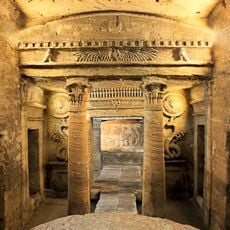
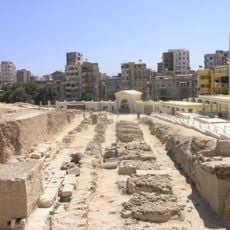
The column stands on the eastern side of the ruined Serapeum, on a hill between the Muslim cemetery of Amoud el-Sawari and the Kom El-Shoqafa catacombs. The shaft is a single block of pink Aswan granite, 20.46 m tall, with a grey granite capital. Two pink granite sphinxes, one inscribed for King Horemheb, lie west of the column.
The shaft is a single monolith of pink granite from Aswan, 20.46 m tall and estimated at 285 tonnes. It is the only known monolithic column in Roman Egypt and one of the largest ancient monoliths ever erected. The grey granite capital is pseudo-Corinthian.
The community of curious travelers
AroundUs brings together thousands of curated places, local tips, and hidden gems, enriched daily by 93,258 contributors worldwide.