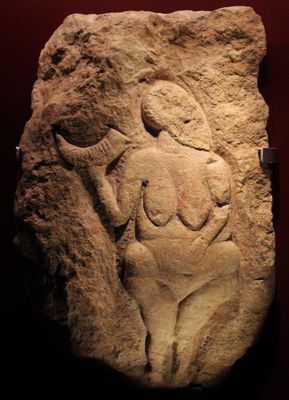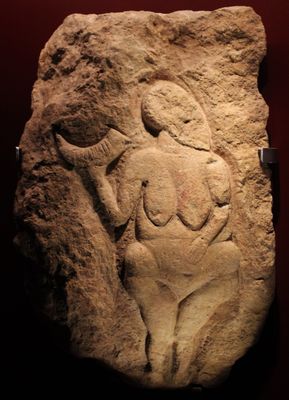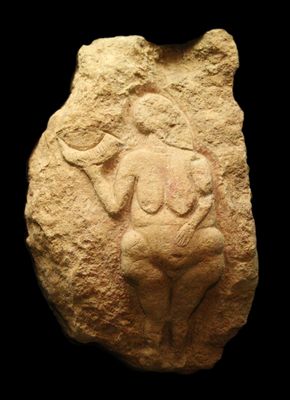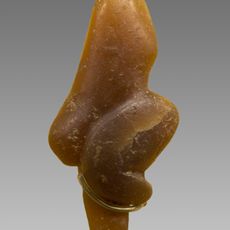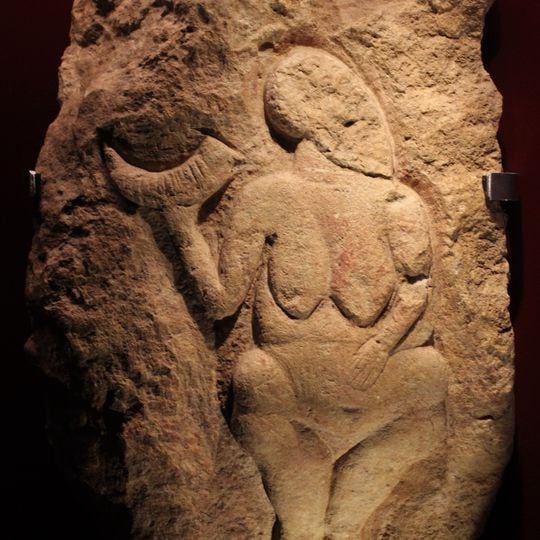
Venus of Laussel, Paleolithic limestone relief in Marquay, France
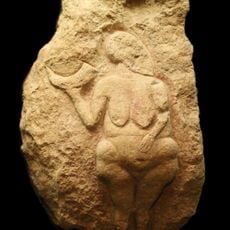
Venus of Laussel is a Paleolithic limestone relief from Marquay in France that depicts a nude female figure. The carving measures 54 centimeters in height and 36 centimeters in width, showing a woman holding a bison horn in her right hand.
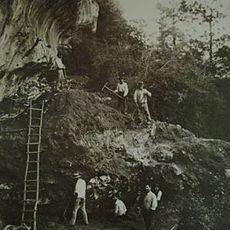
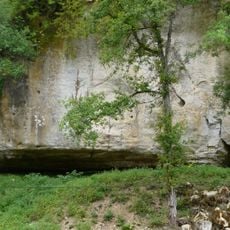
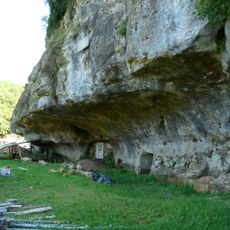
A French physician named Jean-Gaston Lalanne discovered the relief in 1911 during excavations in a rock shelter near Marquay in the Dordogne region. Researchers assign the work to the Gravettian culture and date it to approximately 25,000 years ago.
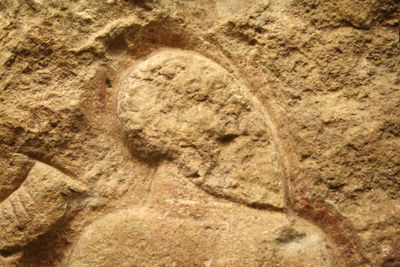
The figure holds a bison horn marked with thirteen notches, which researchers connect to the lunar cycle and its phases. Red ochre pigment still visible on the surface suggests the carving was once fully painted, possibly for ritual purposes in the daily life of its makers.
The original now resides at the Musée d'Aquitaine in Bordeaux, where it sits in a climate-controlled display case. Visitors should allow time to study the fine surface details and the remaining traces of pigment.
The bison horn carries thirteen precisely carved notches, representing one of the earliest known counting systems in human history. These markings may point to an understanding of time cycles or astronomical observation far beyond simple decoration.
The community of curious travelers
AroundUs brings together thousands of curated places, local tips, and hidden gems, enriched daily by 60,000 contributors worldwide.