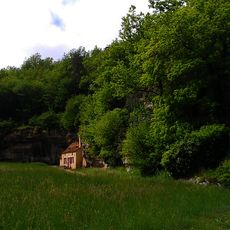
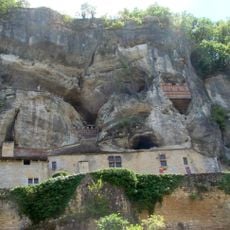
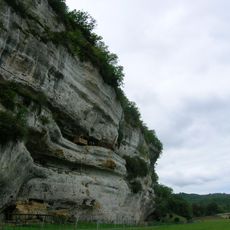
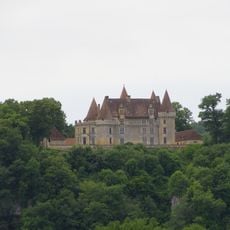
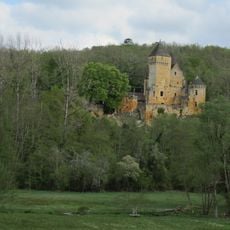
Comarque Cave, prehistoric decorated cave entrance in Les Eyzies, France
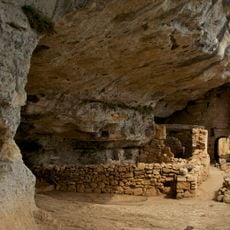
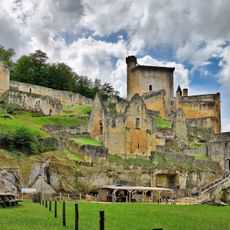
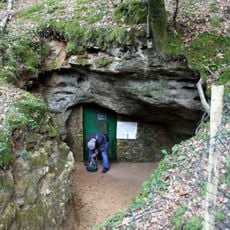
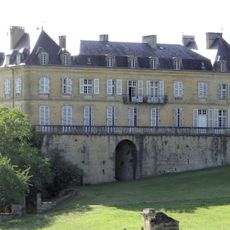
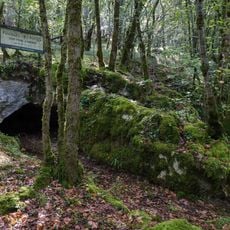
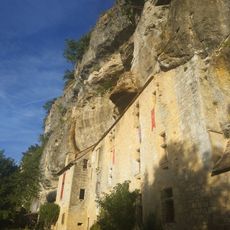
Comarque Cave opens beneath a broad overhanging limestone shelter at the foot of the cliff below Commarque Castle. Its main porch, about 2.5 m wide and 2 m high, leads into a single room roughly 6 by 6 m and up to 3 m high. From there a narrow gallery runs about 22 m, with a 13 m chimney at the junction.
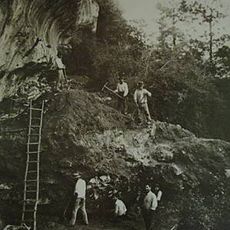
The site appears in records as Hospitalis de Comarco in 1116, then as Comarchia in 1356 and Comarca in 1365. In 1915 a narrow crawl passage of the secondary entrance was walled shut. H. Breuil found broken reindeer, horse and large bovid bones with Magdalenian flints in a low recess of the main chamber. The cave is a classified historical monument.
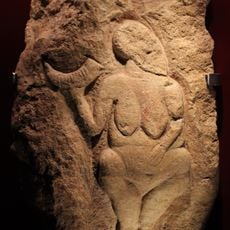
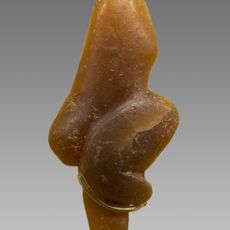
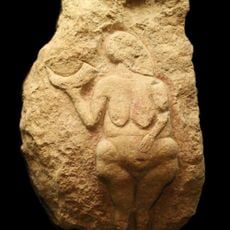
The cave's name appears in records from 1116 as Hospitalis de Comarco, later Comarchia and Comarca. Inside, the best-known work is a pregnant woman engraved on a rock protrusion in the main hall; the lower walls also carry metal tool marks from later fittings that partly damaged the Paleolithic decoration.
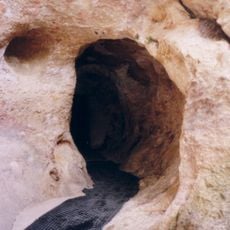
The entrance sits about 95 m above sea level, just above the Grande Beune, in the deepest part of the porch at the cliff foot; three mounds of fallen earth, rubble and boulders block the way in two places. The porch opens north. Inside, the single hall is roughly 6 × 6 m and up to 3 m high, with a clay floor strewn with rock blocks, and the rear gallery is narrow, so expect crawling.
The cave has two entrances and two interior levels, and its floor level has shifted over millennia: about 25 cm higher in the Magdalenian, 80 cm to 1 m higher in the Neolithic, then dropping several metres in the Middle Ages after a very rainy episode before silting back up.
The community of curious travelers
AroundUs brings together thousands of curated places, local tips, and hidden gems, enriched daily by 93,511 contributors worldwide.