Shohei Köprüsü, Railway bridge in Chiyoda, Japan
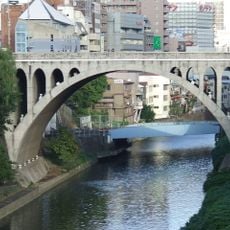
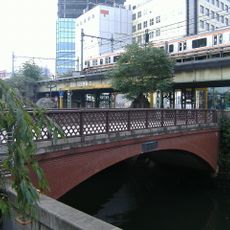
Shohei Bridge is a steel railway bridge in Kanda-Sudachō 1-chōme and Kanda-Awajichō 2-chōme, Chiyoda, Tokyo, carrying the JR East Chūō Main Line over what is now Sotobori-dōri. It has three spans of 12.70 m, 20.15 m and 12.70 m, a total length of 44.2 m, and buckle-plate girders made in 1904 by Harkort of Duisburg, Germany.
The bridge was erected in July 1908 for the Kōbu Railway, when the Chūō Main Line was extended from Shōheibashi Station to Manseibashi Station and crossed the former Soto-bori road. Its girders were made in 1904 by Harkort'sche Fabrik of Duisburg, Germany, and carry a plate reading "HARKORT. DUISBURG-GERMANY. 1904." The brick abutments were built together with the Kōbai-gashi and Manseibashi viaducts.
The bridge carries a maker's plate reading "HARKORT. DUISBURG-GERMANY. 1904.", a visible trace of the German firm Harkort'sche Fabrik that produced the girders. Its name comes from the adjacent Shohei Bridge over the Kanda River, and the brick abutments merge into the Kōbai-gashi and Manseibashi viaducts.
The bridge carries the JR East Chuo Main Line over what is now Sotobori-dori, between Kanda-Sudacho 1-chome and Kanda-Awajicho 2-chome in Chiyoda ward. It is not a pedestrian crossing; the closest station is Awajicho on the Marunouchi Line. The Shohei Bridge over the Kanda River stands just north of it, and the brick abutments can be seen from the street below.
The bridge carries a maker's plate reading "HARKORT. DUISBURG-GERMANY. 1904.", evidence that its girders were cast in Germany. It is considered the oldest buckle-plate girder still in use at its original position in Japan.
The community of curious travelers
AroundUs brings together thousands of curated places, local tips, and hidden gems, enriched daily by 93,412 contributors worldwide.