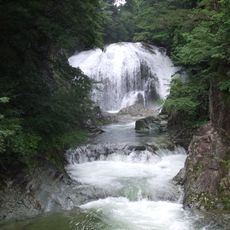
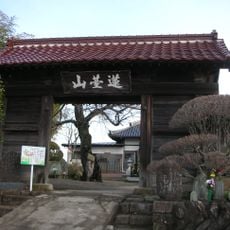
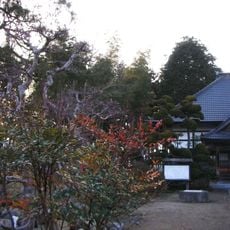
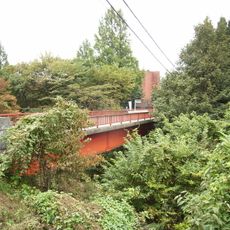
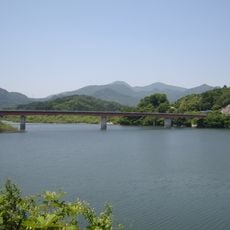
Izumigatake, Mountain summit in Izumi-ku, Japan.
Izumigatake is a mountain summit located in Izumi-ku that rises to approximately 1,175 meters. Multiple hiking trails wind through the surrounding forest and vegetation, offering different routes to reach the peak.
In the Edo period Izumigatake was a shared common mountain (iriai-yama) of nine villages. Six of them merged in 1889 into Miyagi District's Izumigatake Village, while the other three joined Nekitada Village and gave up their rights, leaving the mountain to Izumigatake Village, renamed Neshiraishi in 1897. Rain-making rites were held here in droughts, including a seven-day ceremony on the summit in 1853; the last record dates from 1933, and a Suijin monument was erected in 1895.
The name comes from the springs (izumi) on the mountain, whose water feeds the Hiza River, one of the Nanakita River's sources. Villagers once called it Dakeyama, and rain-making rites were held on the summit, including a seven-day ceremony recorded in 1853; the last was in 1933. A water-deity stele was erected in 1895.
Five marked trails lead up: the Suijin course past a water-deity monument, the Kakkō course with the best views, the Omote course through old-growth forest, the Kitaizumi traverse, and the Kamishika course, which uses the ski lift to Usagi-daira; the lift ride takes about 13 minutes and the summit is roughly 90 minutes from the top station. The lift is idle for about a month before and after the winter ski season.
The summit triangulation point stands at 1,172.18 metres, slightly below the 1,175-metre height given for the mountain. The summit is the last-formed cone of the Funagata range, built of andesite in the Quaternary, and its three stepped terraces up from Yoshi-no-daira come from successive lava flows.
The community of curious travelers
AroundUs brings together thousands of curated places, local tips, and hidden gems, enriched daily by 93,651 contributors worldwide.