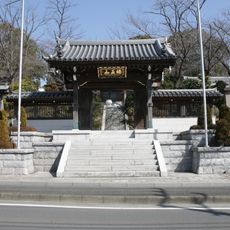
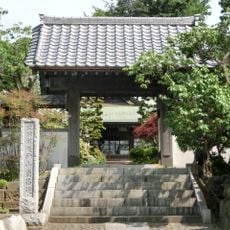
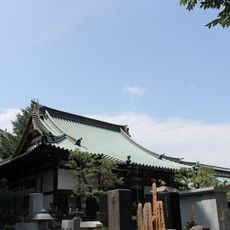
永谷天满宫, Shinto shrine in Japan
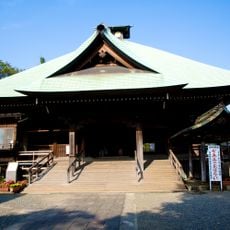
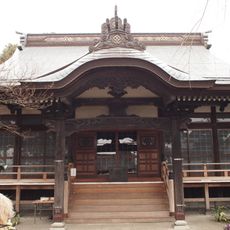
Nagaya Tenmangū is a Shinto shrine in Kamieinagaya, Kōnan-ku, Yokohama, dedicated to Sugawara no Michizane. Its shintai is a wooden image of Michizane said to be under 6 cm tall and carved by Michizane himself before his exile to Dazaifu. The shrine stands near the site of the residence of Sugawara no Atsushige, and the former bettō-ji Shōshō-in adjoins it.
According to the Shinpen Sagami no Kuni Fudokikō, the Michizane statue came to Sugawara no Atsushige (Shūsai), son of Michizane, who settled at Nagaya in Kamakura District and venerated it. In February 1493 the image appeared in a dream to Uesugi Norikuni of the Takuma-Uesugi, who built the hall and enshrined it as the go-shintai. Uesugi Noritoshi rebuilt it in 1582, when the bettō temple Teishō-in was also founded.
The shrine's festivals follow the 25th of the month: Hatsu-Tenjin on 25 January, the regular grand festival on 25 September, and Nō-Tenjin on 25 December, with Ōharae purifications on 30 June and 31 December. Every twelfth year, in the Year of the Ox, a special grand festival is held at which the statue of Michizane is shown publicly.
The shrine is a five-minute walk from Kami-Nagaya Station on the Yokohama Municipal Subway Blue Line. It sits near the Kami-Nagaya Station entrance intersection of the Yokohama Ring Road 2. The former bettō temple Shōshō-in, the site of Sugawara no Atsushige's residence, stands nearby.
The shrine's go-shintai is one of three tiny statues of Sugawara no Michizane, just under 6 cm tall, said to have been carved by Michizane himself before his exile to Dazaifu. The other two are kept at Dazaifu Tenmangū and Dōmyōji Tenmangū; together they are called the Three Heavenly Deities of Japan. The statue is shown only in the Year of the Ox, once every twelve years.
The community of curious travelers
AroundUs brings together thousands of curated places, local tips, and hidden gems, enriched daily by 93,436 contributors worldwide.