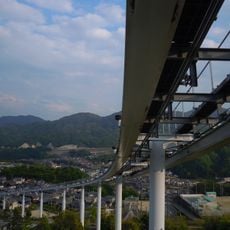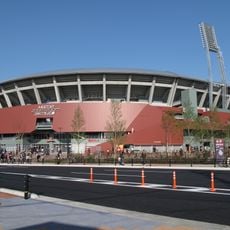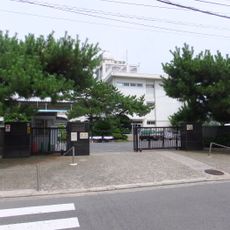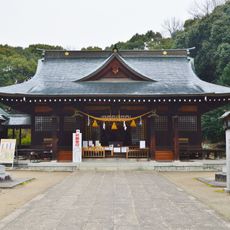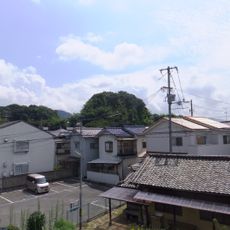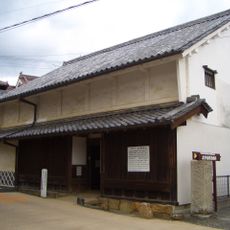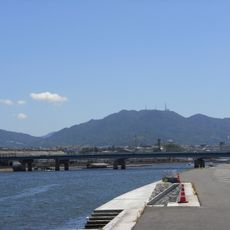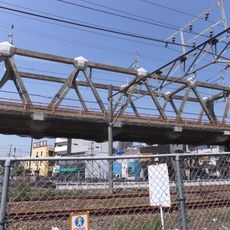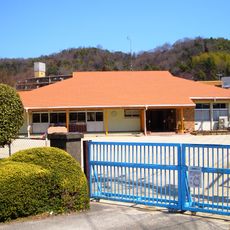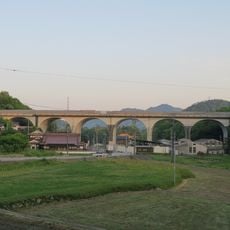
Senohachi, Mountain pass in Aki-ku and Higashihiroshima, Japan
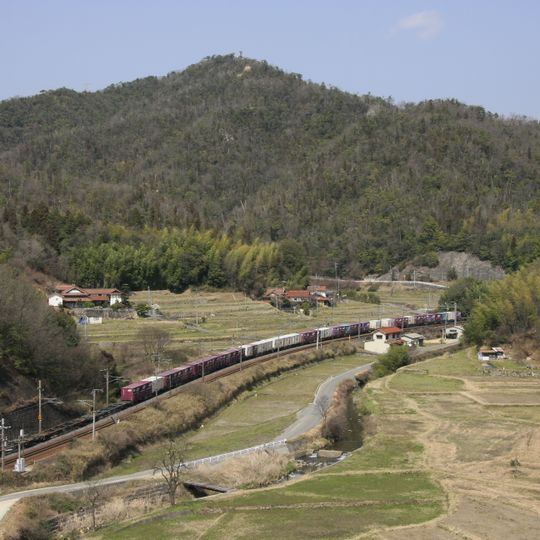
Senohachi is the 10.6 km section of the Sanyo Main Line between Hachihonmatsu and Seno stations, crossing the watershed between the Seno River, which flows into Hiroshima Bay, and the Kurose River, which reaches the Seto Inland Sea. The line climbs a continuous 22.6‰ grade, and the wooded hill above the track meets terraced fields and a cluster of houses where a maroon and white train runs along the lower slope.
Senohachi is the 10.6 km section of the Sanyo Main Line between Hachihonmatsu and Seno stations, opened by the Sanyo Railway on 10 June 1894. To save money the company took the shortest route, producing a continuous 22.6 per mil climb on the uphill track. Alternatives via today's Geibi Line or through Kumano were dropped, partly under military pressure just before the First Sino-Japanese War. The line runs beside the old Sanyodo's Oyama Pass.
Senohachi is a well-known spot for railway photographers, who come to watch freight trains being pushed up the 22.6‰ climb by helper locomotives. The name is also familiar from Kiyotaka Nishimura's mystery novel "Tokkyu Sakura Satsujin Jiken", which uses the uncoupling of a helper while running as its trick, and from the manga "Karechi" by Kunihiko Ikeda, whose 16th chapter is titled "Senohachi".
Senohachi is a 10.6 km railway section between Hachihommatsu and Seno stations on the Sanyo Main Line, not a hiking area. The climb toward Hachihommatsu reaches a continuous 22.6 ‰ gradient, and helper locomotives are attached to uphill freight trains at Hiroshima Freight Terminal and released at Saijo. The line crosses a divide between the Seno River, which reaches Hiroshima Bay, and the Kurosé River, which reaches the Seto Inland Sea. The section is prone to landslides and floods; the July 2018 heavy rain buried it and reopening took over a month.
Senohachi is not a hiking pass but a 10.6 km steep grade on the Sanyo Main Line between Hachihommatsu and Seno stations, opened by the Sanyo Railway on 10 June 1894. Its 22.6‰ climb made it a bottleneck: from the steam era until 2002, helper locomotives were uncoupled from some trains while still moving, and a Seno engine depot stood by the station until 1987.
The community of curious travelers
AroundUs brings together thousands of curated places, local tips, and hidden gems, enriched daily by 94,049 contributors worldwide.