Takuhi-jinja, Shinto shrine in Japan
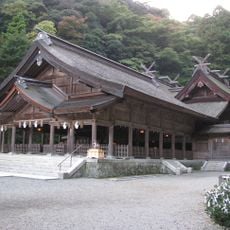
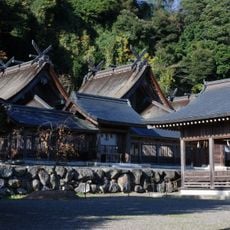
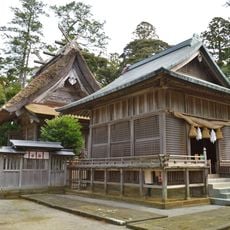
Takuhi-jinja is a Shinto shrine on the 8th station of Mount Takuhi, the highest peak on Nishinoshima in the Oki Islands. Its main hall, linked to the worship hall by a rare tsūden corridor, was built in 1732 by Osaka carpenter Torii Jinbee, with parts prefabricated in Osaka and assembled by carpenters from Yonago. The complex was designated an Important Cultural Property in 1992.
The shrine's origin story in the 'Takuhi Engi' tells of a light that shone over the sea for several nights during the reign of Emperor Ichijō (10th–11th century) and then flew into Mount Takuhi, where villagers found a rock shaped like a Buddhist statue and built a shrine there. In the Kamakura period, the Oyamasha shrine was placed under the control of the Oki provincial governor Sasaki Yasukiyo, who in 1276 confirmed lands for the monk Jiren. The temple Unjō-ji was likely founded in the Nanboku-chō period, and the site remained a combined shrine-temple until the Meiji separation of Shinto and Buddhism in the early Meiji era, when it became the present shrine. It was ranked as a prefectural shrine in 1918.
The name Takuhi derives from taku, 'to burn', and hi, 'fire', referring to the beacon fires lit on the mountain as a night landmark for Japan Sea shipping. The shrine's festival on 23 July features Oki Dozen kagura, a prefectural intangible folk cultural property, danced from around 8 p.m. after the main hall rite. Until the Meiji era the site was a temple, Unjō-ji, and the deity was called Takuhi Gongen.
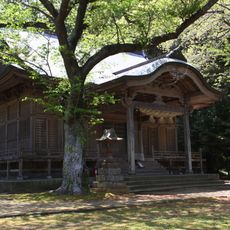
The shrine stands on the southwest slope of Mount Takuhi, about halfway up the eight-gō mark, and is reached on foot; the precinct is long east to west, with the worship hall at the east end facing west and its south side projecting over a cliff. The main hall, connecting corridor and worship hall form one Important Cultural Property, restored between 1997 and 1999. The annual festival is held on 23 July, with kagura from around 8 p.m.
The 1732 main hall was built in Osaka by the carpenter Torii Jinbei, in his last years, and assembled on site by carpenters from Yonago. Only its west side, facing the approach, carries carving; the north and east sides, set against the rock cave, are almost undecorated.
The community of curious travelers
AroundUs brings together thousands of curated places, local tips, and hidden gems, enriched daily by 94,769 contributors worldwide.