Kudaraō Shrine, Shinto shrine in Osaka Prefecture, Japan
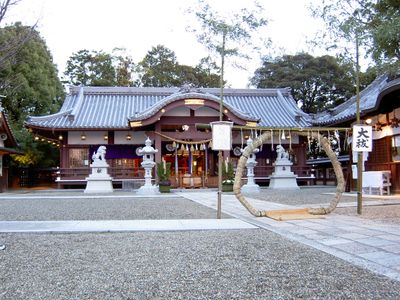
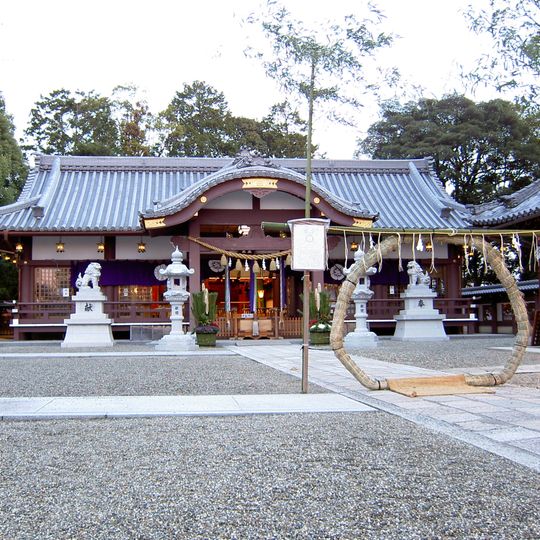
Kudaraō Shrine is a single-story shrine building in Hirakata with a broad gray tiled roof that curves gently at the ends and a raised gable over the central entrance. Its dark wooden facade carries white plaster panels above the doorway, and a purple banner hangs beside the entrance. Three stone lanterns stand in front, and a thick twisted straw rope with white zigzag paper strips crosses the gravel forecourt, held up by a bamboo pole with a white sign board. The present honden is a one-bay Kasuga-zukuri structure with cypress-bark roofing, moved here from Kasuga Taisha in 1808.
After Baekje fell, the royal descendant Shōkō received the surname Kudara no Konikishi. His great-grandson Kyōfuku, governor of Mutsu, found 900 ryō of gold in 749 and was promoted to junior third rank; he moved the family residence from Naniwa to Kawachi. There he built Kudara-ji temple and this shrine, and the court later established a mausoleum for his son Nantei. Repeated fires led to decline before the shrine came under Kōfuku-ji and was restored; the current honden, moved from Kasuga Taisha, dates to 1808.
The name Kudaraō derives from Kudara no Konikishi, the surname granted by the court to the Baekje royal descendant Shōkō (Zenkwang) after Baekje's fall. The shrine honours that lineage's ancestors; until the Edo period the deity was Gozu Tennō, later identified as Susanoo. A purple banner hangs beside the entrance, and a thick twisted straw rope with white zigzag paper strips crosses the gravel forecourt.
The shrine stands at 1-68 Nakamiya Nishinocho, Hirakata, about ten minutes on foot from Miyanosaka Station on the Keihan Katano Line; by bus from Hirakata-shi Station, get off at Nakamiya Byoin-mae and walk 100 m west. The adjacent Kudara-ji temple ruins are a Special Historic Site. The gravel forecourt is crossed by a straw rope hung with white paper strips, so walk around its bamboo support rather than under it.
The shrine's main hall was moved here from Kasuga Taisha in Nara, with which the shrine's later patrons, Kōfuku-ji, were closely linked; the present building dates from 1808 (Bunka 5) and is a single-bay structure in the Kasuga style with a cypress-bark roof. The deity enshrined was called Gozu Tennō until the Edo period.
The community of curious travelers
AroundUs brings together thousands of curated places, local tips, and hidden gems, enriched daily by 94,343 contributors worldwide.