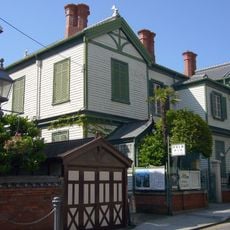
Houseboat, Historic gozabune houseboat in Naka-Yamate-dōri, Kobe, Japan
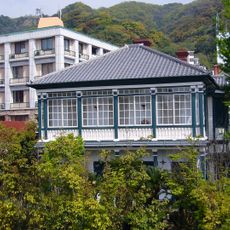
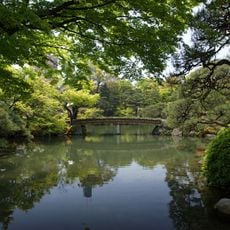
The Houseboat (Funayakata) is the cabin section of a river gozabune, a daimyo pleasure boat of the Himeji domain, now standing by the pond of Sōraku-en in Kobe. It is a two-storey wooden structure, 43.74 m² in area, five bays long and one bay deep, with a gabled, stepped roof once thatched in cypress bark and now covered in tiles. The hull was discarded; only the cabin survives, set at the water's edge so it appears to float.
The structure is the cabin of a river gozabune used by the Himeji domain; fittings bearing the Honda family crest date it to between 1682 and 1704. By the late Edo period it was already on land near Shikama port. In 1939 the businessman Uo Kenji had it restored and moved to Maiko, and in 1980 it was reassembled in Sōraku-en.
The name funayakata refers to the roofed cabin of a river gozabune, the daimyo pleasure boat used for sankin-kotai travel and excursions. The Himeji domain kept this cabin at Shikama port; a black-ink inscription reading "Omeshi kawa-goza" found on a hidden part of the balustrade during dismantling confirmed it served the lord himself.
The houseboat sits within the Sōraku-en garden and is part of a larger grounds that can be explored on foot. Nearby train stations make it convenient to reach on public transportation.
The houseboat holds the designation of Important Cultural Property of Japan, underscoring its exceptional status. This recognition reflects how rare and valued its construction methods are for preservation.
The community of curious travelers
AroundUs brings together thousands of curated places, local tips, and hidden gems, enriched daily by 93,447 contributors worldwide.