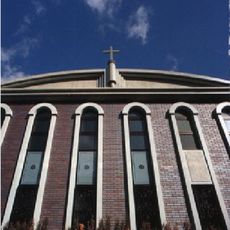
Hongan-ji Kobe Betsuin, Buddhist temple in Chūō-ku, Japan.
Hongan-ji Kobe Betsuin is a Jōdo Shinshū temple in Chūō-ku whose main hall, completed in 1930 and rebuilt in 1995, has five Indian-style spires and stained glass windows. A bronze statue of Shinran Shonin stands in front of the hall, and the interior uses chair seating instead of tatami mats.
The temple traces back to Zenpuku-ji, founded in 1573 by Takeda Uenosuke Nobuhisa in Settsu Province after he converted to Jōdo Shinshū. In 1908 Nishi Hongan-ji appointed Ōtani Son'yu as resident priest, making it a branch temple; the wooden main hall burned in 1917, and a new hall with Indian-style spires was completed in 1930, earning the nickname "Modern Temple". It became Hongan-ji Kobe Betsuin in 1960, and the current building dates from 1995.
The temple is nicknamed "Modern Temple" for its 1930 hall with Indian-style spires and stained glass. It belongs to the Jōdo Shinshū Honganji-ha school and is directly under Nishi Hongan-ji in Kyoto. The hall has chair seating instead of tatami, and Buddhist wedding ceremonies are held in its multipurpose facilities.
The temple stands in Shimoyamate-dōri, Chūō-ku, a short walk from Hanakuma Station's west exit (Hankyū Kōbe Kōsoku line) or five minutes from Nishimotomachi Station's east exit (Hanshin). JR Kōbe, Kōsoku Kōbe and Ōkurayama subway stations are each about 15 minutes on foot. The hall has chair seating rather than tatami, and the multipurpose building holds a hall and meeting rooms.
The current hall, completed in 1995, keeps the Indian-style exterior of the 1929-1930 reconstruction, with five spires and stained glass. A bronze statue of Shinran Shonin stands in front of the main hall. The interior is unusual for a branch temple: no tatami in the inner sanctum, but chair seating.
The community of curious travelers
AroundUs brings together thousands of curated places, local tips, and hidden gems, enriched daily by 93,990 contributors worldwide.