Fujisakidai Baseball Stadium, Baseball stadium in Chūō-ku, Kumamoto, Japan
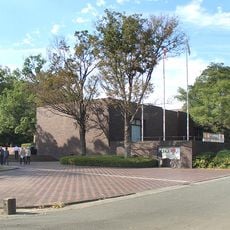
Fujisakidai Baseball Stadium is a baseball ground inside Kumamoto Castle Park in Chūō-ku, Kumamoto. Its main stand was rebuilt in 1996, and the broad facade is clad in flat grey panels with two small dark openings high on the wall; a sloping section and a band of glass panels sit to the left, with exposed crisscrossing roof beams above. Below, an open concrete understory with pillars supports a railed walkway and a straight staircase to the ground.
The stadium was built for the 1960 National Sports Festival on the site of the former Fujisaki Hachiman Shrine, which burned in the 1877 Satsuma Rebellion. The 2016 Kumamoto earthquake damaged the outfield, stands and lighting; emergency repairs finished by 7 July 2016 allowed the prefectural high school tournament to proceed, and full restoration was completed in April 2017.
The stadium's outfield stands were built around seven camphor trees, the largest with a 12 m trunk circumference and an estimated age of about 1,000 years; the group was designated a national Natural Monument in 1924. A branch of the left-field tree overhangs the field by about 1.5 m, and by rule a batted ball that lodges in the branches counts as a home run. Since 2018 the ground has been called Lib Work Fujisakidai Stadium.
The stadium is accessible on foot or by local bus from other parts of the neighborhood and situated near small shops and cafes for pre or post-game visits. Checking the local game schedule in advance helps you plan your visit during the baseball season.
Seven camphor trees stand behind the outfield stands, the largest with a 12 m trunk circumference, 28 m height and roughly 1,000 years of age; they were designated a national natural monument in 1924. Because the trees cannot be pruned without permission, a batted ball that lodges in their branches is ruled a home run.
The community of curious travelers
AroundUs brings together thousands of curated places, local tips, and hidden gems, enriched daily by 94,829 contributors worldwide.