Gyōgan-ji, Buddhist temple in Isumi, Japan.
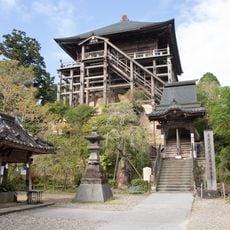
Gyōgan-ji is a Tendai Buddhist temple in Isumi, Chiba Prefecture, with the mountain name Higashi-Mitsumuriyama and the cloister name Muryōju-in. A sandō leads up to a two-storey tower gate (rōmon) built in 1735, beyond which stands the main hall, one of the largest temple buildings on the Bōsō Peninsula, its interior railings carved by Nami no Ihachi in 1706. The former abbot's residence of 1800 is divided into six rooms.
Tradition holds that Ennin founded the temple in 849 under the name Muryōju-in, then abandoned it. In 1180 it was rebuilt at Hagiwara Chadanoyatsu at the wish of Dainagon Reizei Yukimoto, who gave it the name Gyōgan, and in 1586 it was moved to its present site. From 1369 the Gyōgan Bunsho documents record Tendai activity, and in the Edo period monks from Kan'ei-ji served here, making it a major temple with 96 branch temples in Kazusa and Awa.
The temple's name comes from Reizei Yukimoto, who had it rebuilt in 1180. From 1369 it kept the Gyōgan Bunsho, several dozen collections of religious writings. In the Edo period monks from Kan'ei-ji in Ueno served here, and the temple grew to 96 branch temples in Kazusa and Awa.
The temple grounds are accessible via marked pathways that connect the different buildings across the site. Wear comfortable shoes, as the paths cross uneven ground and follow the natural slope of the land.
The carvings in the main hall and the former abbot's residence are attributed to Nami no Ihachi (Bushi Ihachirō Nobuyoshi) and dated by inscriptions to 1706. His wave motif is said to have influenced Hokusai's Great Wave off Kanagawa.
The community of curious travelers
AroundUs brings together thousands of curated places, local tips, and hidden gems, enriched daily by 93,728 contributors worldwide.