Suzuki Kantarō Museum, Biographical museum in Noda, Japan.
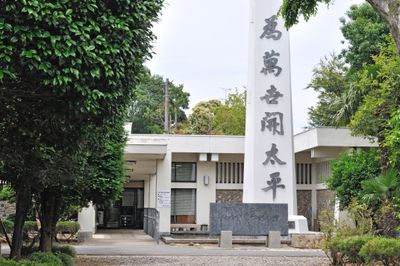
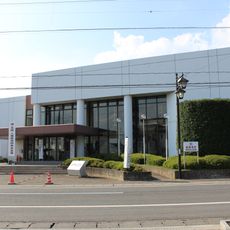
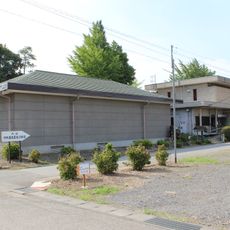
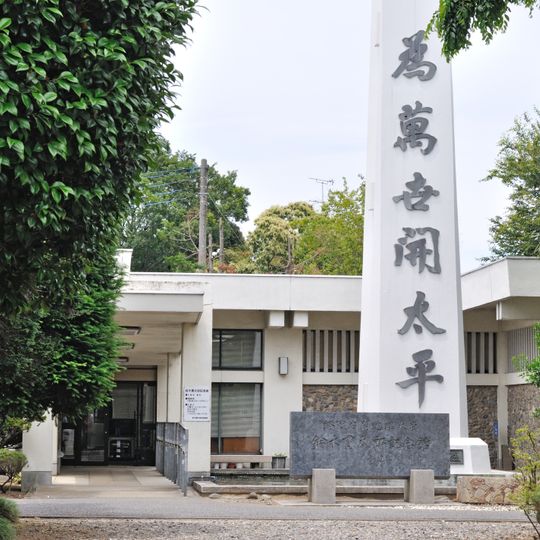
The Suzuki Kantarō Museum is a single-storey building with a flat white concrete facade, standing behind a low stone-edged bed in Noda. A tall narrow concrete pillar rises above the roofline on the right, carrying a vertical column of dark metal characters read as 爲萬世開太平. At its base a dark stone slab engraved with lighter text is flanked by two short stone posts; the facade has a dark glass entrance on the left and two large dark-framed windows.
Founded in 1963 near the former residence of Suzuki Kantarō, the museum preserves records of his pivotal role during Japan's surrender. An oil painting on display depicts the Imperial Conference where this crucial national decision took place.
The museum keeps more than 1,000 of Suzuki's belongings in Sekiyado, the town of his family register where he spent his childhood and final years. Its best-known piece is the oil painting "The Last Imperial Conference" by Shirakawa Ichirō, showing the 1945 meeting at which Suzuki's cabinet decided Japan's surrender in the presence of Emperor Shōwa. In 2019 the family of Teruzo Ando, involved in the February 26 Incident, donated his belongings.
The museum has been closed since October 2019, when Typhoon Hagibis damaged the building and a seismic survey found it too weak; reopening is still under study. It stands at 1273 Sekiyado, Noda, Chiba, next to the site of Suzuki's former home. Buses from Kawama and Tobu-Dobutsu-Koen stations stop at Sekiyado-daimachi, a two-minute walk away; there are 12 general and 2 accessible parking spaces.
The collection includes items donated by the family of Teruzo Ando, who was involved in the February 26 Incident of Japanese military history. These donations provide deeper context for understanding the period of instability that affected the nation.
The community of curious travelers
AroundUs brings together thousands of curated places, local tips, and hidden gems, enriched daily by 95,354 contributors worldwide.