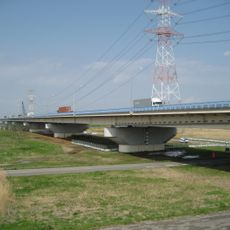
關宿水閘門, Water gate bridge in Sekiyado, Japan.
The Sekiyado Water Gate is a concrete and steel installation spanning the Edo River to regulate water levels and flow. The structure uses fixed piers combined with movable gate panels that can be raised or lowered to manage water conditions.
The Tone River was linked to the Edogawa in 1641 by the Tone River eastward diversion project, which spurred shipping in the Kanto region. Before the Meiji era, a projecting dike called a hobashi limited inflow from the Tone. In 1911, as part of Edogawa improvement works, a lock and regulating gate were planned to replace the hobashi; construction began in 1918 and was completed on 31 March 1927.
The name Sekiyado comes from the former town of Sekiyado, at the junction where the Tone and Edo rivers part. The gate's two steel mitre gates, 12 metres wide and 143 metres long, are still worked by hand, and pedestrians and cyclists cross the top to the far bank; general vehicles are barred.
Pedestrians and cyclists can cross the top of the gate to the opposite bank, but general vehicles are not allowed. The gate stands where the Tone and Edo rivers diverge, in Goka, Ibaraki Prefecture.
The lock uses two steel mitre gates, each 12 metres wide and 143 metres long, operated by hand. Built between 1918 and 1927, it sits where the Tone and Edo rivers divide, and pedestrians and cyclists can cross the top, though general vehicles cannot.
The community of curious travelers
AroundUs brings together thousands of curated places, local tips, and hidden gems, enriched daily by 94,032 contributors worldwide.