Yoroinosode, Cliff natural monument in Kasumi, Kami, Japan.
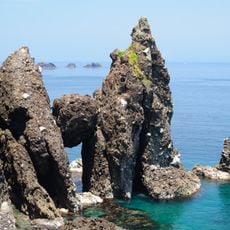
Yoroinosode is a 65-metre-high, 200-metre-long sea cliff on the Kasumi Coast, rising from the water at a 70-degree angle. Its rhyolitic dacite and tuff show columnar and sheet jointing cut by 15 parallel fissures, a formation created by volcanic activity between about 10 and 3 million years ago.
Yoroinosode is a sea-eroded cliff of rhyolitic dacite and tuff, formed by volcanic activity between about 10 and 3 million years ago. Fifteen parallel fissures cut across its columnar and platy jointing. It was designated a national natural monument on 30 May 1938 under the name Yoroizode.
The name comes from the cliff's 15 parallel fissures cutting across columnar and platy joints of rhyolitic dacite and tuff, whose pattern recalls the kusazuri skirt plates of a samurai suit of armor. The site was designated a national natural monument on 30 May 1938 under the name Yoroinosode.
Yoroinosode stands on the Kasumi Coast in Kasumi, Kami, Hyogo. From Kasumi Station on the San'in Main Line it is a 20-minute walk, or take a Zentan bus to Ichinichi and walk a short distance. Sightseeing boats of the Kasumi Maru leave from Kasumi fishing port's east harbour for views from the sea.
The cliff's 15 parallel fissures cut across columnar and platy jointing in rhyolitic dacite and tuff, a pattern compared to the hanging plates of a samurai's armor skirt. Nearby stand the孔雀洞門 (Kujaku Cave) on the western cliff and the columnar-jointed Takanosu Island and Hachinosu Island offshore.
The community of curious travelers
AroundUs brings together thousands of curated places, local tips, and hidden gems, enriched daily by 94,371 contributors worldwide.