Achi Shrine, Shinto shrine in Achi, Nagano Prefecture, Japan
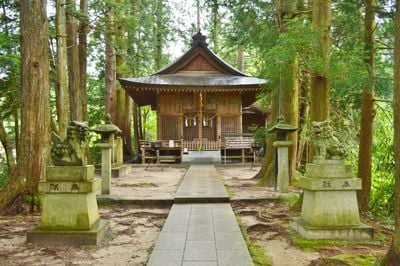
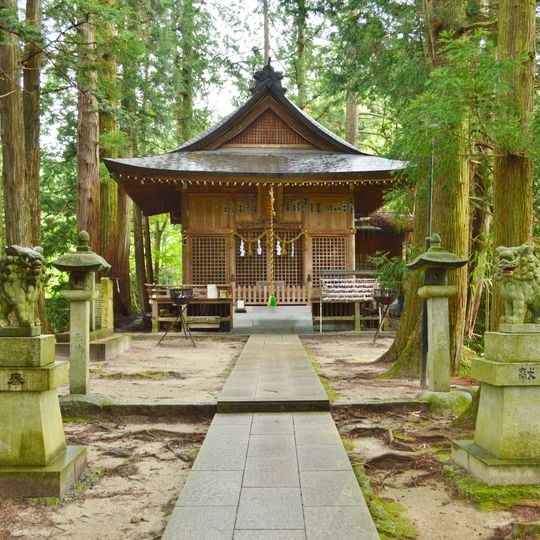
Achi Shrine in Achi Village, Nagano Prefecture, has a front shrine (mae-miya) and an inner shrine (oku-miya) about 2 km apart along the Achi River. The front shrine's light-brown wooden worship building has a dark curved roof with a triangular gable and white ornaments along the eaves, lattice doors crossed by a rope with white zigzag streamers, and a low offering box before the doors. The inner shrine, called Kawai-ryo, stands on a triangular promontory where the Motodani and Kuro rivers join the Achi River, and a moss-covered boulder there is worshipped as an iwakura.
According to shrine tradition, the deity Amano-Iwato-wake-no-Mikoto descended to Shinano in the spring of the fifth year of Emperor Kōgen's reign and became ancestor of the Achi no Hōfuri. The Hara family long conducted its rites. In the Tenryaku era (947–957), Tokutake clan members carried the two deities to Togakushi Shrine's Chūsha and Hōkōsha. Edo-period vermilion-seal documents record the shrine once being called Sannō Gongen-sha.
The shrine's name comes from the Achi no Hōfuri, the priestly lineage descended from Ame no Yagokoro-omikane no Mikoto, who according to shrine tradition descended to Shinano and became their ancestor; the Hara family later carried out the rites. The grounds include a rear shrine (okumiya) about 2 km upstream along the Achi River, where a moss-covered boulder is venerated as an iwakura, a natural rock seat of the deity.
The shrine stands in Chisato, Achi Village, Nagano Prefecture, about a 10-minute drive from the Sonohara Interchange. The main shrine (maemiya) is at Chisato 489 and the rear shrine (okumiya) at Chisato 497, roughly 2 km upstream along the Achi River. The okumiya sits on a promontory where the Hongoya and Kurokawa streams join to form the Achi River.
The okumiya, 2 km upstream along the Achi River from the maemiya, stands on a triangular promontory where the Motodani and Kuro rivers meet, a spot called Kawai-no-misaki. Archaeologist Iwao Ōba identified the moss-covered boulder on the mound as an iwakura, a natural rock formation whose protrusions align with the four cardinal directions; the sun rises on its eastern extension at the winter solstice.
The community of curious travelers
AroundUs brings together thousands of curated places, local tips, and hidden gems, enriched daily by 94,440 contributors worldwide.