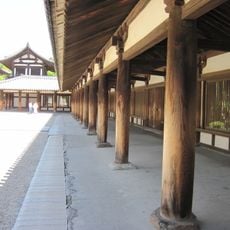
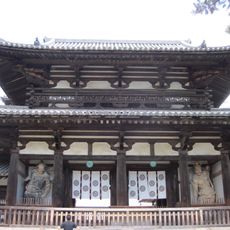
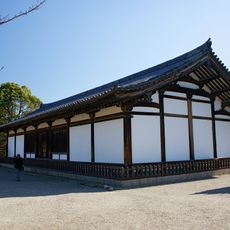
Kakuan-ji, Buddhist temple in Yamatokōriyama, Japan.
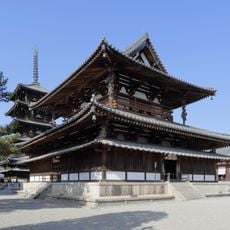
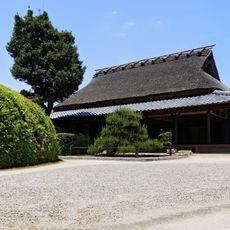
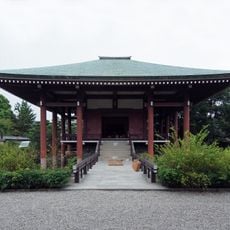
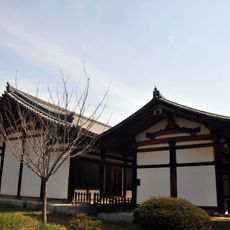
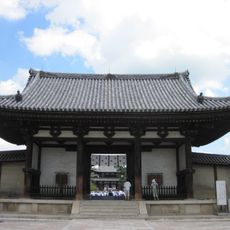
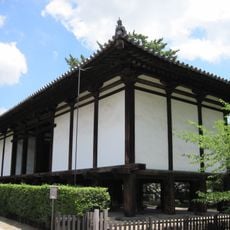
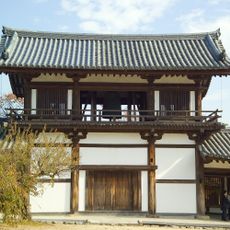
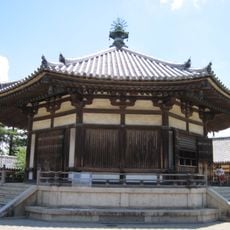
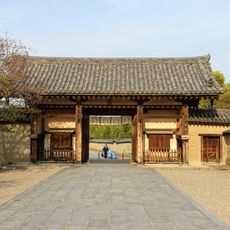
Kakuan-ji is a Shingon Risshu temple near the confluence of the Yamato and Saho rivers in Yamatokōriyama. Its main hall was rebuilt in 1606, and the grounds include a 1260 stone hōkyōintō pagoda and a mountain gate. The temple is also known as Nukadadera.
Kakuan-ji grew from a clan temple of the Nukatabe family. A 747 record claims its origin lies in the Kumagori Shōja, a 621 foundation attributed to Prince Shōtoku, though scholars now reject this link. A Nara-period map shows a full temple layout by 757–765. It declined in the Heian period, was revived by Eison and Ninshō in the late Kamakura period, burned in 1499, and lost its land in 1580.
The temple is also called Nukata-dera, after the Nukatabe clan whose family temple it was. Its name is read "Kakuan-ji", not "Gakuan-ji". A Kamakura-period document and a set of wooden Four Heavenly Kings statues, transferred from Sugawara-ji where Gyōki died, carry inscriptions linking them to the temple's past.
Kakuan-ji lies near the confluence of the Yamato and Saho rivers at the southern edge of Yamatokōriyama. From Kintetsu Hirahata Station it is about a 20-minute walk; the An-dō town community bus stops at Kakuanji-guchi, five minutes on foot. By car it is roughly three minutes from the Yamato Mahoroba smart interchange on the Nishi-Meihan Expressway.
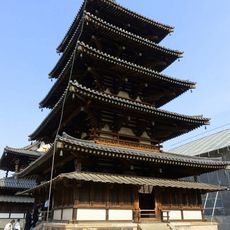
The five-story pagoda was moved to Shitennō-ji in 1600 by Toyotomi Hideyoshi's heir Hideyori, in exchange for a one-hectare temple estate that allowed Kakuan-ji to be rebuilt. The pagoda's transfer is recorded as fulfilling that agreement.
The community of curious travelers
AroundUs brings together thousands of curated places, local tips, and hidden gems, enriched daily by 93,666 contributors worldwide.