Vlasina Lake, Reservoir in Southeast Serbia
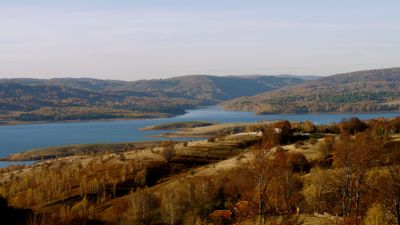
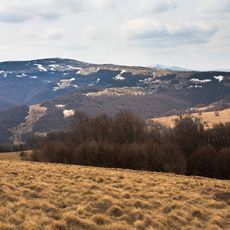
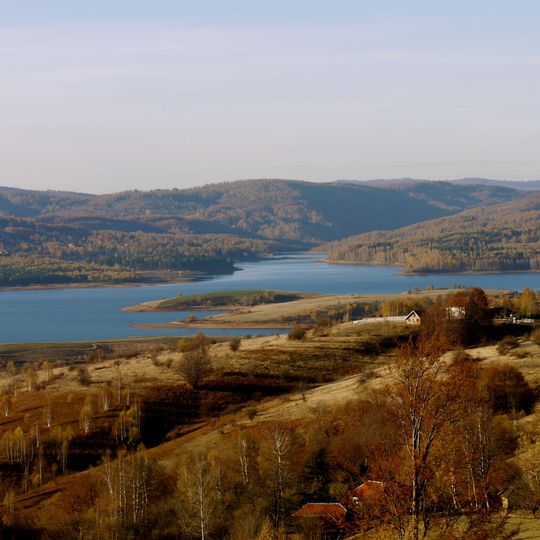
Vlasina Lake covers 16 square kilometers at an elevation of 1213 meters and is the highest and largest artificial body of water in Serbia. The shoreline is surrounded by forested hills, while two fixed islands and smaller floating patches of land move across the water.
The Vlasina peat bog, drained by the Vlasina River, was dammed between 1946 and 1949; the reservoir began filling on 9 April 1949 and reached its full capacity of 165 million cubic metres in 1954. The earth dam stands 34.43 m high and 239 m long at its base. After flooding, chunks of peat broke loose from the new bottom and drifted as floating islands, a few of which remain today.
The lake takes its name from the Vlasina River, whose old course lies beneath the water. The floating peat islands were once tethered to the shore; from the mid-1970s their movement was recognised as unusual. Willows and birches have grown on some of them.
Water temperatures rise enough for swimming in summer, while the surrounding area is suitable for hiking or boating. Access to the shores is possible at several points, with some areas easier to reach than others.
Two forested islands, Dugi Del and Stratorija, remain in fixed spots, while smaller peat islands drift across the water surface. These floating patches form when chunks of peat break away from the shore and wander independently.
The community of curious travelers
AroundUs brings together thousands of curated places, local tips, and hidden gems, enriched daily by 93,780 contributors worldwide.