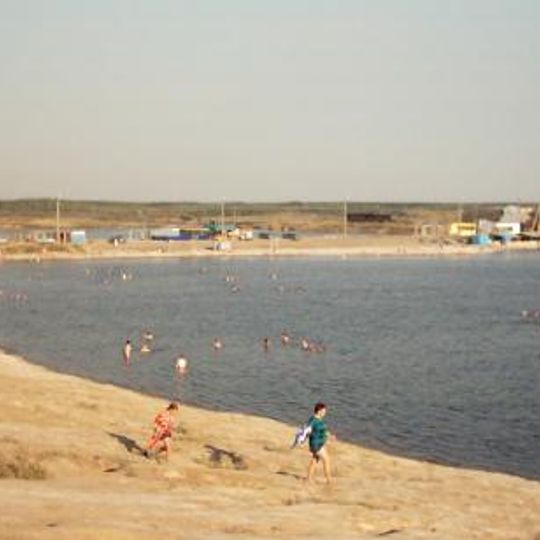
Razval, Salt lake in Sol-Iletsk, Russia.
Razval is a salt lake on the southeastern edge of Sol-Iletsk, formed in a flooded salt quarry. It covers 6.8 hectares and reaches 22 metres deep. The water is a saturated sodium chloride brine of 200–330 g/l, similar to the Dead Sea, with no living organisms or vegetation. The shoreline is sandy, and the far bank is low and flat.
Salt was mined here from 1754, when the Tuz-Tyube hill above the Ilezk salt dome was opened as an open pit; by the late 19th century the quarry was up to 35 m deep, 300 m long and 240 m wide. In April 1906 floodwaters of the Peschanka river filled the pit, creating Razval over 6.8 hectares with depths to 22 m. In 1979 groundwater breached the eastern slope and brine drained into an underground cavity; the lake had largely refilled by the mid-1980s.
The name Razval comes from an old Russian word for a pit left by disordered salt mining. Locals also call the lake Solyonka, from sol, salt. Bathers come from across the Ural region and neighbouring Kazakhstan, seeking relief from psoriasis, rheumatism and asthma. Light diamonds on Sol-Iletsk's flag and coat of arms stand for the lake's salt-saturated water.
The lake lies on the southeastern edge of Sol-Iletsk. Its brine stays liquid even in hard frost, but below 2–3 m the water remains at negative temperatures year-round, so swimmers stay near the surface. The site has been developed for tourism since 2002, with restaurants, a beach disco and accommodation; a freshwater lake next door offers electric boats and water slides.
The lake's brine is denser than the human body, so swimmers cannot sink. Below 2–3 m the water stays at negative temperatures all year, while the surface warms in summer heat. No living organism or vegetation survives in it. Light diamonds on Sol-Iletsk's flag and coat of arms stand for these salt-saturated waters.
The community of curious travelers
AroundUs brings together thousands of curated places, local tips, and hidden gems, enriched daily by 93,428 contributors worldwide.