Orenburg Child Railway, railway line in Russia
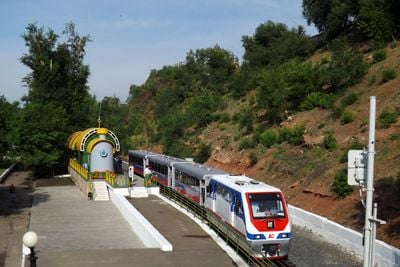
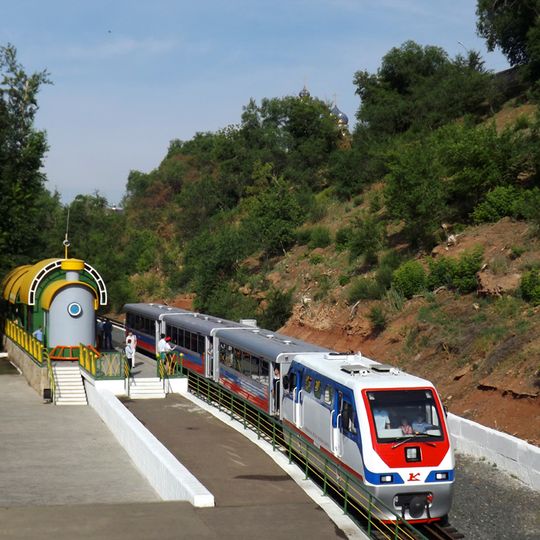
The Orenburg Child Railway is a rail system designed specifically for children, stretching about 6 kilometers through the city on narrow-gauge tracks. The line has three stations with small, colorful trains operated by children and adults, allowing young riders to experience real train operations firsthand.
The decision to build the railway in what was then Chkalov was taken in 1953, when the city was the centre of the Orenburg Railway. Construction began on 19 May and was completed in 68 days; the line opened on 26 July 1953, named after P. A. Kobozev. The first train was hauled by steam locomotive Kv4-017 with five pre-revolutionary four-axle coaches. The line was later extended by 800 metres and the terminus moved; the Plyazh halt closed in 1957, and in 1958 all rolling stock was withdrawn and the old coaches rebuilt as freight platforms.
The station and trains display a simple, child-friendly design with bright colors and small buildings that invite exploration. The railway reflects how the city makes train experience accessible to young learners while building responsibility and technical interest in them.
Trains run from the beginning of June to the end of August; outside that season the rolling stock stands in the open at Dubki station, which has no track layout. Komsomolskaya, the main station, sits in the city centre by the pedestrian bridge over the Ural River. Pionerskaya is a request stop near several beaches, while Kirovskaya and Dubki serve children's health camps.
The line runs along the Ural River floodplain and offers views of the river that marks the border between Europe and Asia. This geographic proximity turns a short train ride into a journey between two continents.
The community of curious travelers
AroundUs brings together thousands of curated places, local tips, and hidden gems, enriched daily by 93,644 contributors worldwide.