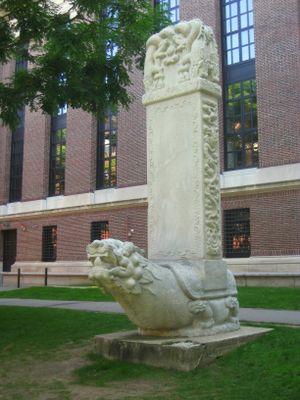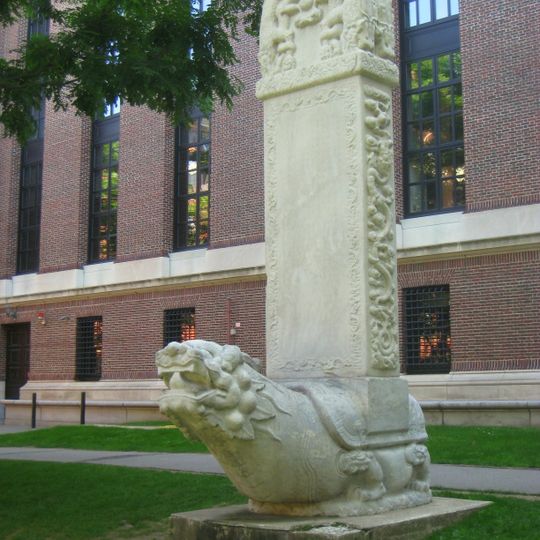
Harvard Bixi, Chinese marble sculpture at Harvard Art Museums, Massachusetts, US
Harvard Bixi is a Chinese marble stele, roughly 17 feet (about 5 meters) tall, set on a carved tortoise-shaped base in Harvard Yard, near Boylston Hall. The upright stone slab is covered on multiple sides with inscriptions and relief carvings.
The stele was made in Beijing around 1820 as a gift from the Jiaqing Emperor to a high-ranking provincial official. It later made its way to Harvard, where it is now held as part of the Peabody Museum of Archaeology and Ethnology's collection.
The stone carries carved Chinese characters and dragon motifs typical of imperial Qing monuments, and visitors can examine them up close from all sides. It stands as one of the few examples of this type of Chinese imperial stonework on display in the United States.
The sculpture stands in Harvard Yard, which is open to visitors during the university's regular hours at no charge. The carvings at the base can be harder to see in winter when snow covers the ground, so a visit in a warmer season gives a better view of the whole piece.
The tortoise-shaped base, called a bixi in Chinese, gives the whole monument its name and is itself a carved object worth examining closely. Many visitors focus on the tall slab above and walk past the base without noticing the detail work along its sides.
The community of curious travelers
AroundUs brings together thousands of curated places, local tips, and hidden gems, enriched daily by 91,800 contributors worldwide.