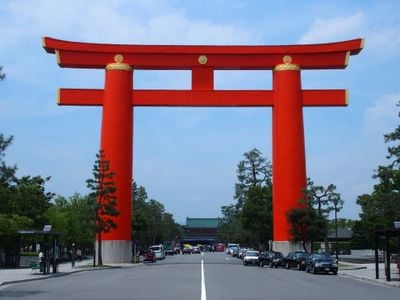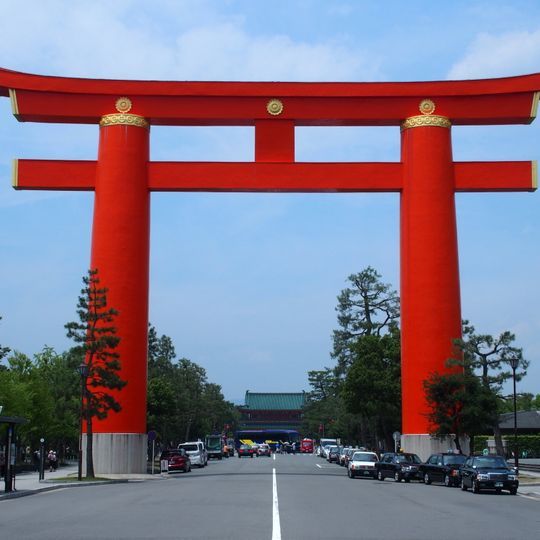
Ōtorii, Grand torii gate at Heian shrine in Sakyo district, Japan
The Ōtorii is a massive red wooden gate about 24 meters tall that forms the entrance to Heian shrine in Kyoto and spans across a wide street. The structure consists of two large pillars with a crossbeam at the top, showing traditional Japanese torii architecture on an impressive scale.
The gate was built in 1928 and connected to Heian shrine, which was founded in 1895 to commemorate 1100 years since Kyoto became the capital. This timeline shows how the gate was added later to highlight the shrine's significant moment.
The gate creates a clear shift between the busy city outside and the sacred space within, making visitors feel the moment of entering a different world. This boundary role is central to how Japanese spiritual spaces are designed and experienced.
The gate is freely accessible year-round and you can walk under it without paying any fee, while the nearby shrine gardens require a small admission charge. The best time to visit is early morning when it is quieter and the light is better for photographs.
The gate is wide enough to be crossed while street traffic simultaneously flows underneath it, making it unusual among large torii gates. This arrangement allows modern life and sacred space to coexist in the same moment.
The community of curious travelers
AroundUs brings together thousands of curated places, local tips, and hidden gems, enriched daily by 91,374 contributors worldwide.