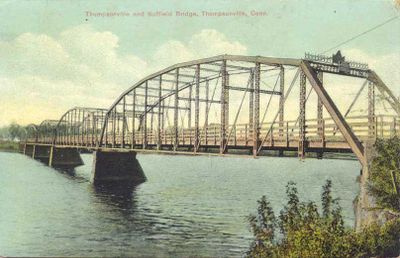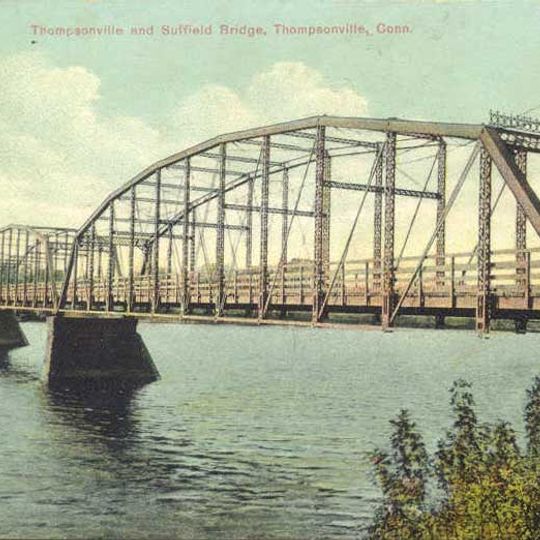
Suffield and Thompsonville Bridge, Truss bridge in Suffield, United States.
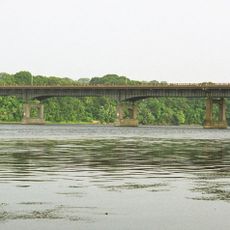
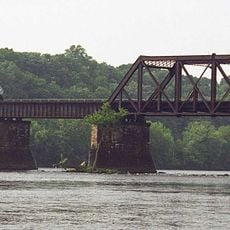
The Suffield and Thompsonville Bridge was an iron truss structure that spanned the Connecticut River with five metal arches supported by four stone piers sunk into the riverbed. The entire crossing measured approximately 1,060 feet between its anchoring points on both banks.
The Berlin Iron Bridge Company constructed this crossing in January 1893 as part of a broader wave of industrial bridge building across the Northeast. The iron superstructure remained in service for more than 75 years before its removal in 1971, though the stone foundation piers persist in the river.
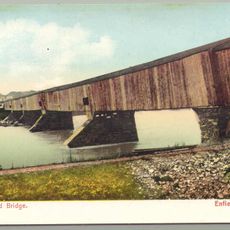
The structure connected two communities separated by the Connecticut River, serving as a vital link that shaped local trade routes and travel patterns. Both towns depended on this crossing for their economic relationship and daily interaction.
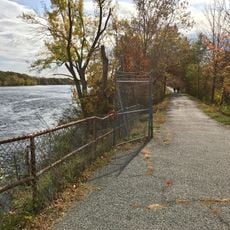
The four stone piers remain visible from various viewpoints along the riverbank and from the towns on either side. Visitors can best observe these remnants during seasons when vegetation is minimal, making the stonework easier to spot from roads and pathways near the river.
Nathan Hemenway was the first person hired to collect tolls at this crossing, charging pedestrians three cents and wagon teams twelve cents for passage. His role illustrates how the bridge operators depended on these small but frequent payments to maintain the structure.
The community of curious travelers
AroundUs brings together thousands of curated places, local tips, and hidden gems, enriched daily by 92,816 contributors worldwide.