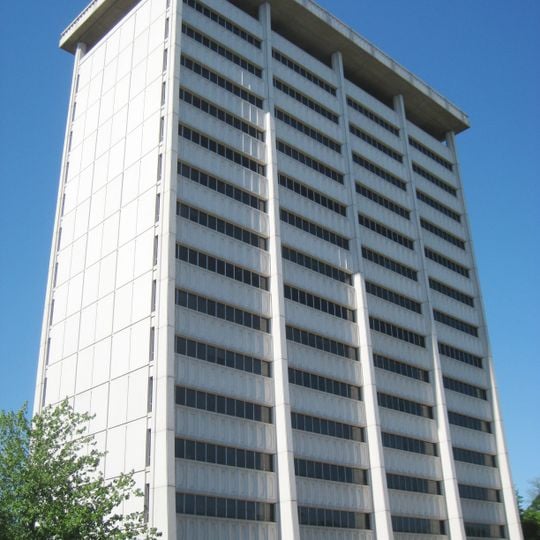
William James Hall, Academic building at Harvard University campus in Cambridge, United States.
William James Hall is a 15-story building on Harvard's campus featuring four wide bays supported by slender columns and topped with a projecting roof slab. Its facade of precast concrete panels set within a structural frame creates a striking modernist appearance.
The building was completed in 1963 to house Harvard's expanding behavioral science departments and research programs. It was designed by architect Minoru Yamasaki during a period when the university was strengthening its social sciences research capabilities.
The building honors William James, a pioneer in experimental psychology whose work shaped academic research at Harvard. It represents the university's shift toward modern behavioral sciences in the 20th century.
The building houses offices, laboratories, classrooms, and a library serving the psychology, sociology, and social sciences departments. Access is typically restricted to university members and authorized visitors.
The building represents a striking departure from Harvard's traditional Gothic style, showcasing instead a minimalist geometric design. This bold shift from classical university architecture made it a notable example of modern functionalism on campus.
The community of curious travelers
AroundUs brings together thousands of curated places, local tips, and hidden gems, enriched daily by 92,767 contributors worldwide.













![Gund Hall - Graduate School of Design [Harvard University]](https://img9.digsty.com/MxS4GVZZ6ceYqvq7BmvRuupz_5GuWC2qfiT2RNpQJoc/rs:fill:230:230:1/g:fp:0.5:0.5/czM6Ly9hcm91bmR1cy8xNC8xNjU4ODA5MjItOTIwYmE4YTUuanBn.jpg)
